Artificial intelligence in S’pore classrooms: How do we know it’s making a difference for teachers?
https://www.straitstimes.com/singapore/parenting-education/artificial-intelligence-in-spore-classrooms-how-do-we-know-its-making-a-difference-for-teachers
=====
Artificial intelligence in S’pore classrooms: How do we know it’s making a difference for teachers?
News analysis
Artificial intelligence in S’pore classrooms: How do we know it’s making a difference for teachers?
Get ST's newsletters delivered to your inbox
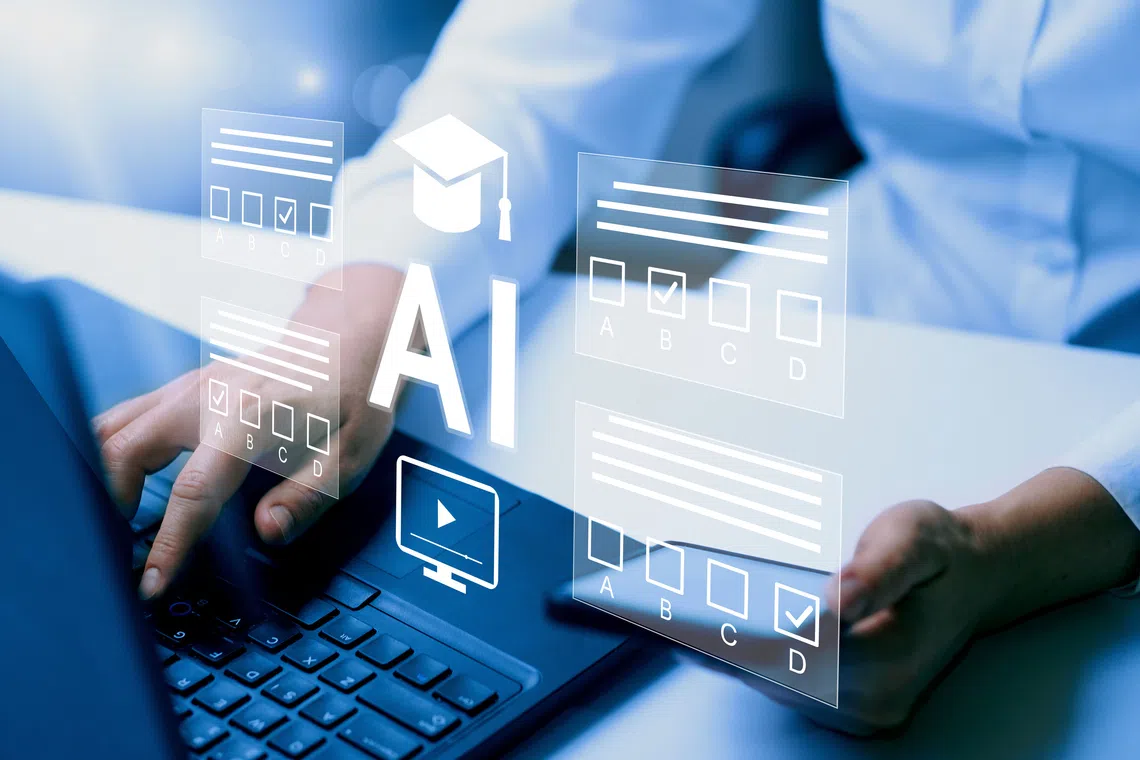
While AI has become a regular part of teaching, its benefits are less about saving time and more about changing how that time is spent.
PHOTO: GETTY IMAGES
Follow topic:
Gabrielle Chan
The Straits Times
Published Oct 18, 2025, 05:00 AM
SINGAPORE – At first glance, it may seem counterintuitive. Teachers in Singapore are among the world’s fastest adopters of artificial intelligence (AI) and, to be fair, they probably thought it would mean shorter working hours.
But this has not quite happened.
Three in four teachers here use AI tools to teach or support learning, according to the latest Teaching and Learning International Survey (Talis). They also
clock an average of 47.3 hours a week
– slightly higher than six years ago, and above the global average.What AI has done is to reshape how teachers spend their working hours. Eight in 10 teachers say such tools help them plan lessons or automate administrative work, but the time saved often gets absorbed by other responsibilities – from verifying AI outputs to learning new systems to providing more personalised support for students.
While no one expected AI to drastically shorten teachers’ hours, the technology was often seen as a way to ease workload pressures. The latest findings show that while AI has become a regular part of teaching, its benefits are less about saving time and more about changing how that time is spent.
The Ministry of Education (MOE) has rolled out AI-enabled tools for marking and lesson planning, but the expected gains in efficiency are not immediately visible.
Across industries, this tension is not unusual. Automation rarely reduces working hours outright; instead, it reshapes how people work.
Top stories
Swipe. Select. Stay informed.

Singapore
Can Singapore keep the lights on while cutting carbon from its energy sector?

World
‘Hopefully they won’t need it’: Trump says it’s too soon for Tomahawks in talks with Ukraine’s Zelensky

Singapore
Obesity, poor mental health of concern despite progress in other areas, S’pore health survey shows

Singapore
21 hurt in accident between 2 lorries in Sungei Kadut, driver nabbed for allegedly running red light
Singapore
No more ‘unlimited liability’ for consultants in govt construction contracts from Dec 1

Business
Lawsuit against PropNex subsidiary over ‘99-to-1’ deal dropped, says property group
Asia
Japan has boundless supply of rare earths that can blunt China’s dominance but are costly to mine
For teachers, the question is not whether AI saves time, but whether it makes their time count for more.
Time is not saved but reallocated
Teachers of science, humanities and language subjects that The Straits Times spoke to agree on one thing: AI does not reduce workload; it has redefined it.
Lesson planning, parent communication, co-curricular activities and counselling still take up much of teachers’ time, Talis found.
For one secondary school science teacher, AI helps her generate quizzes, collate data on student performance and assist with lesson planning.
But the hours freed up are quickly filled with other duties: verifying AI outputs, learning new features, teaching students to use AI responsibly or updating curriculum resources.
“We haven’t reached the stage where we’ve reaped the rewards of AI,” she said, adding that the nature of work has changed even as hours remain the same. “The time savings are still being reinvested into other items on our to-do list.”
And teachers say that while technology offers support, it also brings new layers of checking, tweaking and training.
There may also be an initial learning curve, with the average age of Singapore teachers being 43. The secondary school science teacher described the school’s AI tools as having a “steep learning curve”, and its interface “complicated” and “not user-friendly”.
Similarly, a geography teacher said that he saves time using AI to write testimonials for students, but he does not keep track of time spent and just moves on to his next task.
A lot of the job depends on how much a teacher wants to invest in the lesson, the geography teacher said. “I can spend an hour preparing for a lesson, or three to four hours to design a more interactive experience.”
It also varies for different subject teachers. Language teachers said they often cannot use AI tools to mark compositions or essays because English and literature papers tend to be more subjective.
There is also what some call a “verification tax” – the time spent checking AI-generated work. Despite being among the highest adopters of AI, Singapore teachers are also among the most cautious, the Talis findings showed.
“No teacher takes an answer from AI wholesale,” a language teacher said. Time is spent double-checking feedback from AI, even if they use a feedback assistant, or ensuring the output is accurate.
“AI takes more time than it cuts,” said the science teacher.
If not time savings, then what for?
For teachers, the promise of AI lies in not doing less, but in doing better. AI should take over tasks that actually can be automated, and not be involved in aspects that require a teacher’s touch, the language teacher said.
“Students do not receive automated feedback from AI as well as a 40-minute sit-down with me,” she said. “What is missing is the relational aspect.”
AI, in other words, should free teachers to focus on work that matters most – understanding students, offering personalised guidance and improving the quality of teaching.
MOE has been pushing for learning to be better tailored for each child, and early signs show that AI could help.
Using the ministry’s automated marking tool, the science teacher can gather and analyse data on students’ common mistakes.
“Most teachers do not mind spending time to learn how to use AI tools, but we want it to deliver what it is meant to deliver – better personalised feedback and differentiation,” she said.
For another, AI aids teachers in preparing more engaging worksheets or suggesting games for classroom bonding. The minutes saved go towards higher-value work, such as deeper student support, rather than reducing overall hours.
====


====
AI also has potential to lighten administrative burdens, a long-cited pain point for teachers.
For example, the language teacher’s school is trying out automating the tracking of student absences, such that parents and form teachers immediately get a text once a student reports late or is absent from school.
“That’s one fewer job for form teachers, because we previously had to call parents daily to ask for the reason for absence or to inform them of their child being late,” she said.
The challenge is that administrative duties still crowd out what they enjoy most – teaching.
MOE data shows about 3.7 per cent of teachers are flexi-adjuncts, often assigned lighter teaching loads and fewer administrative or co-curricular responsibilities.
Rethinking AI’s effectiveness in education
The success of AI in education cannot be measured by teachers’ working hours alone, and should instead be judged by whether it helps them teach better.
Impact should be assessed through outcomes such as student progress, teaching quality and teacher well-being – not just efficiency metrics.
Some teachers already use AI to track learning patterns or support differentiated instruction.
Meaningful success also depends on usability and trust. Tools must integrate seamlessly into teachers’ routines and produce reliable, explainable results. Otherwise, the time saved in one task will simply be spent verifying another.
Ultimately, the true measure of AI’s success in education may be simple: freeing teachers to do what technology cannot – to teach, connect and care.
Read the full story and more
Want more exclusives, sharp insights into what’s happening at home and abroad? Subscribe now.
- Access all subscriber-only content on ST app and straitstimes.com
- Easy access any time via ST app on one mobile device.
- E-paper with 2-week archive so you won’t miss out on content that matters to you
Enjoy these subscriber benefits


 Posts
Posts


No comments:
Post a Comment