Long hours, huge stress. So what keeps a teacher going?
For subscribers
Long hours, huge stress. So what keeps a teacher going?
A recent global survey showed that teachers in Singapore put in longer hours than their peers. Some still find the profession deeply rewarding.


Get ST's newsletters delivered to your inbox
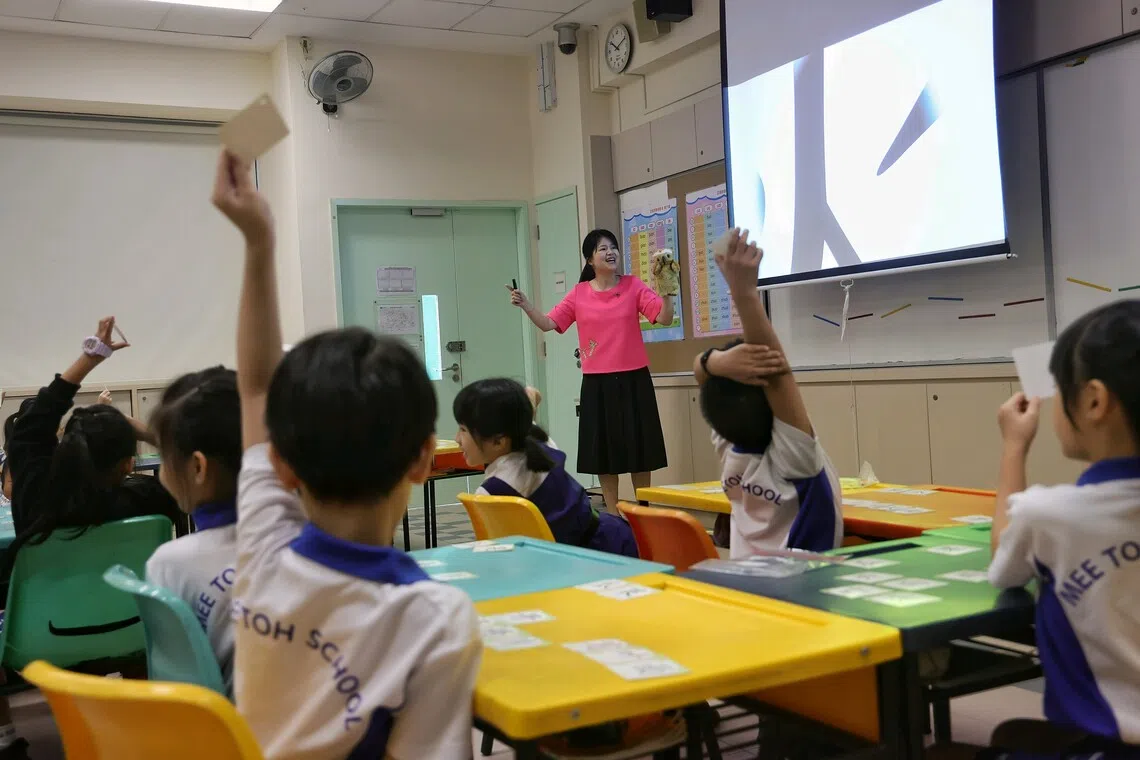
Teachers in Singapore are the third hardest-working in the world, according to an OECD global survey released on Oct 7.
ST PHOTO: KEVIN LIM
Follow topic:
Published Oct 22, 2025, 05:00 AM
Updated Oct 22, 2025, 05:00 AM
Sandra Davie
Senior Education Correspondent
The Straits Times
=========
Teaching and Learning International Survey
, released on Oct 7, has drawn public attention to just how hard Singapore’s teachers work. It also prompted many to ask the Ministry of Education to relieve teachers of administrative load and other tasks outside of in-classroom teaching.But five teachers, including a novice teacher I spoke to, had a surprisingly different take on the findings unveiled by the Organisation for Economic Cooperation and Development (OECD) survey.
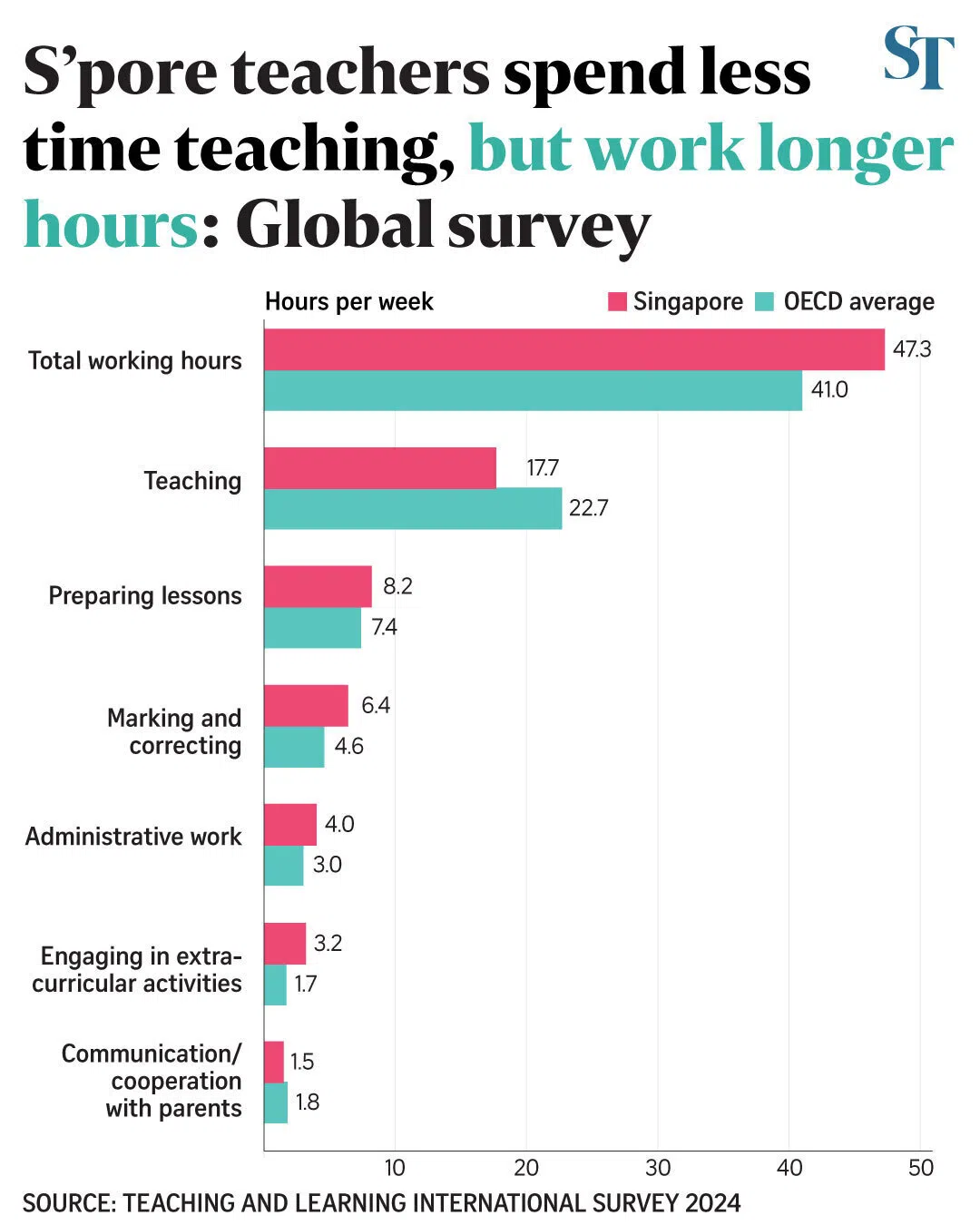
In a nutshell, according to the survey, Singapore’s teachers reported working an average of 47.3 hours a week, higher than the OECD average of 41. They are the third hardest-working in the world, up from seventh in the 2018 survey.
The breakdown on the hours spent in the classroom and outside, though, show that teachers here spend fewer hours teaching and marking, but clock more work time overall due to non-teaching tasks, such as lesson planning, student counselling, co-curricular activities and communicating with parents.
I spoke to five teachers – a mixture of experienced hands and relatively new entrants – about the findings. Surprisingly, all of them said they work more than 47 hours a week. Adding everything up, they estimated that they easily notch up more than 50 hours of work a week.
But while the general public is asking for them to be relieved of some of their non-teaching duties, the teachers themselves had a different take. Their point: Work outside of the classroom should also be considered part of a teacher’s work and it is just as important.
A primary school teacher, who is form teacher to several students who live in rental flats located near the school, has strong views about this.
Top stories
Swipe. Select. Stay informed.

Singapore
S’pore Govt to share classified threat intelligence with critical sectors to beef up national security

Singapore
Largest industrial district cooling system begins operations in Ang Mo Kio

Singapore
Judge acquits three women accused of organising procession outside Istana

Singapore
‘Not a ship, but a mothership’: Mindef launches first multi-role combat vessel

Asia
Malaysia school stabbing: 14-year-old suspect to be charged with murder

Singapore
Rising malnutrition among Singapore seniors: How can you prevent this condition?

Singapore
Singapore will continue to deepen strong ties with Japan under new premier: PM Wong

Asia
Turning rubbish into electricity: Indonesia to build huge incinerators to shrink landfill needs
The mother of two who joined the service more than 10 years ago said: “Like many jobs, a teacher’s job is multifaceted, and it’s hard to put what we do, and the hours we spend, into neat little boxes.
“Let’s take just one task, taking attendance. Going by the comments from the public, they see it as an administrative task. But I feel that it is important for the teacher to take attendance every day... I make a mental note to inquire further if a child is suddenly missing school or on MC for a few days. In fact, two years ago, I noticed that one of my students, who was improving in her studies, started missing school. I went to visit her at home and I realised that the home situation had changed. I looked into seeking help for the family through the counsellor in my school and the family service centre nearby. And then, as I live nearby, I went to my student’s home for a week or so, to accompany the girl to school.
“Now I don’t see why all the hours I spent doing that is not considered a teacher’s work. It is important teacher’s work. I am fairly skilled at teaching maths or English, but first I have to get the child into the classroom.”
Teacher, mentor, counsellor
Another teacher, with 15 years of experience, echoed these comments: “We are told we don’t have to give our phone numbers to students, but I do for those who I feel may need to contact me in an emergency, or when they are going through a difficult period at home. So yes, I have spent hours on the weekend, listening to a student recounting the nights when her dad came home drunk and got into huge fights with her mum. And how scared she was.
“So, not only are we teachers, we are also parents, mentors, counsellors, social workers... The list goes on.”
When asked whether she should be relying more on the counsellors and social workers in schools, she said: “I am very appreciative of the counsellor in my school, and I often get her involved, but I do this further down the road.
“I am form teacher to my students and I have built up a relationship with them and sometimes with their parents as well. When they get into trouble and their parents are not around, I am their first point of contact.”
The survey had also flagged that more younger teachers complained of stress and many were planning on leaving teaching.
Among the local teachers surveyed, 40 per cent of younger teachers indicated that they planned to leave the profession within five years. It’s a nine-point drop from 2018, but the figure remains double the OECD average.
A novice teacher, with three years of experience, freely acknowledged the stressful nature of the job. “In my staff room, it’s not just the younger ones, but also the older ones who complain of stress,” she said. “Teaching is a difficult job. Parents complain of managing one or two children. Imagine having to manage 40 of them, educating them and hopefully inspiring them.”
She also said it’s “very normal” for young people of her age group, Gen Z, as they are called, to be wondering if there are better opportunities elsewhere.
“I like teaching... I find it meaningful, but surely it doesn’t mean that there are no other jobs that are just as meaningful, and perhaps, offer better salaries.”
Another one of the veteran teachers admitted to dissuading her Gen Z daughter from teaching because of the stress involved.
“I discouraged my daughter when she wanted to apply to teach because she can’t handle stress well. And yes, I complain of stress as well, but let’s face it, teaching is stressful.
“But still, I love being a teacher because of all the other things I get out of it, such as when I find a creative way to teach a difficult topic, or when an average kid suddenly starts to blossom under my care. Another thing I love is working with really smart and compassionate colleagues. It makes me overlook the stress.”
Asked what would lessen the stress for teachers, two of the five teachers wished some things would be taken off their plates – such as having to sit on event-planning committees and having to take care of a co-curricular activity. However, the veteran teacher said that being in charge of a sports CCA had informed her teaching.
“I have students struggling in class, but surprisingly shining in their CCAs, showing themselves to be good leaders and being able to rally the cooperation of others.
“In a few cases, I have turned kids around by acknowledging the skills and strengths they show in their field and getting them to apply it to their studies. So, although I complain about teachers having to do CCA, I have come to see the usefulness of it.”
What about using AI to take away some of the tasks altogether or shorten the time taken in areas such as marking papers and planning lessons?
Four out of the five teachers say they have tried to use AI in the hope that it would save them time and make them more productive, but their day-to-day reality of using AI has been quite different.
“I have used AI tools out there to create lesson plans, but I find myself spending more time reviewing and moderating AI-generated content. Also, I spend quite a bit of time learning how to use the tools,” said one of them.
An experienced teacher who has looked at many AI-generated lesson plans calls it “AI work slop”.
“It all looks like low effort, sub-par work.”
But even she is optimistic that AI in the future will be much better and be able to create good lesson plans and customise them to suit every student’s progress.
The VIPs – very involved parents
Parents these days are very involved in their children’s education. This does not always make a teacher’s life easier.
Four out of the five teachers I spoke to said they wished parents would stop challenging them and start trusting their professionalism.
Said the veteran teacher: “Parents are much more involved in their children’s education, but they are mostly concerned about their children’s grades. I have had parents asking me how come my students are not doing as well as the students in the next class, although they know full well that my students are not as academically strong.”
She said handling her teenage students used to be easier in the past, because their parents trusted her disciplinary methods.
“When teenagers are testing boundaries, teachers need parental backing most. Now they question our attempts to discipline them.”
The novice teacher recounted how she was not able to sleep for a week because of a parent’s threats. The teacher had remarked on a child’s composition and the parent said she would publicly post these remarks.
“Parents’ expectations are higher and with social media, it’s much easier to instantly broadcast a complaint.
“I wish parents will trust me to do my job. Trust that I am the expert in my field, that every decision I make is in the best interest of the students I am teaching.”
Though the life of a teacher is changing and clearly challenging, three out of the five teachers said they cannot imagine doing any other job.
Said the teacher working with kids living in rental flats: “At the end of the day, teaching is ultimately an act of hope. Every time you teach, you are hoping to educate and inspire your student. Ignite in him the joy of learning, the excitement of discovering something new. If you have a student with a host of problems, you help him solve his problems one by one and hope that it will change the trajectory of his path. Teachers are the most hopeful people I know – they believe everything can be improved through effort and persistence.”
Log in
Read the full story and more
Want more exclusives, sharp insights into what’s happening at home and abroad? Subscribe now.
- Access all subscriber-only content on ST app and straitstimes.com
- Easy access any time via ST app on one mobile device.
- E-paper with 2-week archive so you won’t miss out on content that matters to you
Enjoy these subscriber benefits
Sandra Davie is senior education correspondent at The Straits Times.


 Posts
Posts


No comments:
Post a Comment