Wednesday, April 29, 2026

No more nicknames: PayNow to end alias option for users from June 2026


No more nicknames: PayNow to end alias option for users from June 2026

https://www.straitstimes.com/business/no-more-aliases-paynow-to-end-nickname-option-for-users-from-june-6

2026-04-29

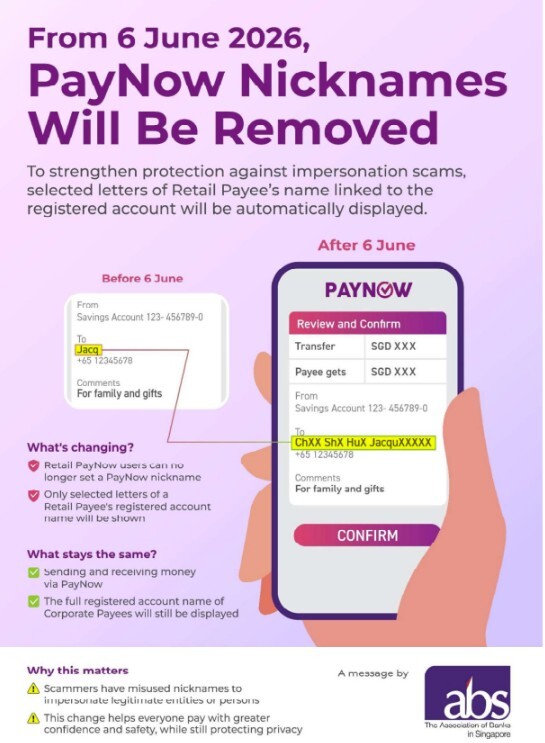
SINGAPORE - PayNow users will no longer be able to customise their display names from June 6. Instead, transactions will reflect the name registered with their bank, with only selected letters shown to protect their privacy.

In a statement on April 29, the Association of Banks in Singapore (ABS) said the PayNow nickname feature for retail customers will be discontinued to strengthen protection against impersonation scams.

Previously, scammers could exploit the nickname feature by using the names of established entities or trusted individuals as their PayNow aliases, allowing them to dupe victims into transferring money to fraudulent accounts.

With this change, PayNow users will be able to see their payee’s verified, registered account name – with only selected letters displayed – before making a transfer or payment.

ABS director Ong-Ang Ai Boon said: “While PayNow has made everyday payments more convenient, it is equally important that users can transact with confidence.

“Discontinuing the nickname feature removes an avenue that scammers can exploit while safeguarding customer privacy.”

The nickname feature has been available to retail users since PayNow was launched in 2017.

Currently, retail users’ registered names with their bank are displayed by default, unless they set a nickname.

From June 6, all display names will be updated automatically to reflect the registered names. No action is needed on the users’ part, ABS said. Users also cannot define which letters will appear in their updated display names.

“The logic for the updated PayNow name has taken into consideration industry best practices, consumer feedback, and is centrally applied to provide consistency. Hence, users will not be able to make changes to the updated PayNow name,” ABS said.


Businesses that use PayNow to receive payments via a unique entity number do not have access to the nickname feature.

Some users welcomed the move as a necessary safeguard. “If this reduces scams, I don’t mind losing the custom name feature. It is too easy for people to impersonate others these days,” Grab driver Francis Goh told The Straits Times.

Others said the change might inconvenience some freelancers and small businesses that usually receive payments on their personal PayNow accounts and have the option to use a nickname.

Tuition teacher Josephine Pereira said she has been using a PayNow alias known to her students and their parents. This change may confuse them, said Ms Pereira.

Tuesday, April 28, 2026

Video 粽子生产线 2026-04-28


My Weight Statistics (2026-04-28) - My Weight Measurement on the 28th of Each Month Since 28 May 2007


My Weight Statistics (2026-04-28) - My Weight Measurement on the 28th of Each Month Since 28 May 2007

My 19-year Weight Management Records from 2007-05-28 to 2026-04-28 (by Calorie Restriction, i.e. Dietary Energy Restriction):


My 19-year Weight Management Records from 2007-05-28 to 2026-04-28 (by Calorie Restriction, i.e. Dietary Energy Restriction):

Note: According to the Singapore Health Promotion Board, a Healthy BMI is greater than18.5 and less than 23.0. A BMI less than 18.5 would mean that the individual is at risk of nutrition deficiency diseases and osteoporosis. 

A BMI equal or greater than 23.0 would mean that the individual is at risk of obesity-related diseases. (Ref: DD-Md2022J28)

As of 2026-04-28,

Note: ### indicates BMI = 23 or > 23

Total number of Monthly Weight monitored was 227 (100%)

The no. of times my healthy BMI between 18.5 and 22.9 was 222 (97.797%)

The no. of times my unhealthy BMI equal or more than 23.000 was 5 (2.203%)

=======================

2007

2007-05-28 morning, my weight = 65.0 kg, BMI = 23.588###

2007-06-28 morning, my weight = 61.0 kg, BMI = 22.136

2007-07-28 morning, my weight = 59.0 kg, BMI = 21.410

2007-08-28 morning, my weight = 58.7 kg, BMI = 21.302

2007-09-28 morning, my weight = 57.5 kg, BMI = 20.866

2007-10-28 morning, my weight = 57.5 kg, BMI = 20.866

2007-11-28 morning, my weight = 56.2 kg, BMI = 20.394

2007-12-28 morning, my weight = 55.5 kg, BMI = 20.140

2008

2008-01-28 morning, my weight = 54.8 kg, BMI = 19.886

2008-02-28 morning, my weight = 54.8 kg, BMI = 19.886

2008-03-28 morning, my weight = 54.5 kg, BMI = 19.777

2008-04-28 morning, my weight = 54.4 kg, BMI = 19.741

2008-05-28 morning, my weight = 54.1 kg, BMI = 19.632

2008-06-28 morning, my weight = 54.6 kg, BMI = 19.814

2008-07-28 morning, my weight = 54.5 kg, BMI = 19.777

2008-08-28 morning, my weight = 54.3 kg, BMI = 19.705

2008-09-28 morning, my weight = 54.9 kg, BMI = 19.923

2008-10-28 morning, my weight = 55.3 kg, BMI = 20.068

2008-11-28 morning, my weight = 54.5 kg, BMI = 19.777

2008-12-28 morning, my weight = 55.6 kg, BMI = 20.177

2009

2009-01-28 morning, my weight = 54.8 kg, BMI = 19.886

2009-02-28 morning, my weight = 55.9 kg, BMI = 20.285

2009-03-28 morning, my weight = 54.8 kg, BMI = 19.886

2009-04-28 morning, my weight = 55.3 kg, BMI = 20.068

2009-05-28 morning, my weight = 55.4 kg, BMI = 20.104.

2009-06-28 morning, my weight = 55.2 kg, BMI = 20.031

2009-07-28 morning, my weight = 55.1 kg, BMI = 19.995

2009-08-28 morning, my weight = 55.2 kg, BMI = 20.031

2009-09-28 morning, my weight = 56.3 kg, BMI = 20.431

2009-10-28 morning, my weight = 55.8 kg, BMI = 20.249

2009-11-28 morning, my weight = 56.2 kg, BMI = 20.394

2009-12-28 morning, my weight = 56.1 kg, BMI = 20.358

2010

2010-01-28 morning, my weight = 55.6 kg, BMI = 20.177

2010-02-28 morning, my weight = 56.5 kg, BMI = 20.503

2010-03-28 morning, my weight = 56.4 kg, BMI = 20.467

2010-04-28 morning, my weight = 55.7 kg, BMI = 20.213

2010-05-28 morning, my weight = 55.1 kg, BMI = 19.995

2010-06-28 morning, my weight = 56.4 kg, BMI = 20.467

2010-07-28 morning, my weight = 55.5 kg, BMI = 20.140

2010-08-28 morning, my weight = 55.8 kg, BMI = 20.249

2010-09-28 morning, my weight = 55.8 kg, BMI = 20.249

2010-10-28 morning, my weight = 55.4 kg, BMI = 20.104

2010-11-28 morning, my weight = 55.6 kg, BMI = 20.177

2010-12-28 morning, my weight = 55.5 kg, BMI = 20.140

2011

2011-01-28 morning, my weight = 55.4 kg, BMI = 20.104

2011-02-28 morning, my weight = 56.5 kg, BMI = 20.503

2011-03-28 morning, my weight = 55.6 kg, BMI = 20.177

2011-04-28 morning, my weight = 55.7 kg, BMI = 20.213

2011-05-28 morning, my weight = 55.6 kg, BMI = 20.177

2011-06-28 morning, my weight = 56.3 kg, BMI = 20.431

2011-07-28 morning, my weight = 56.5 kg, BMI = 20.503

2011-08-28 morning, my weight = 56.9 kg, BMI = 20.649

2011-09-28 morning, my weight = 56.2 kg, BMI = 20.394

2011-10-28 morning, my weight = 56.8 kg, BMI = 20.613

2011-11-28 morning, my weight = 59.0 kg, BMI = 21.410

2011-12-28 morning, my weight = 60.3 kg, BMI = 21.882

2012

2012-01-28 morning, my weight = 61.5 kg, BMI = 22.318

2012-02-28 morning, my weight = 62.7 kg, BMI = 22.753

2012-03-28 morning, my weight = 62.5 kg, BMI = 22.681

2012-04-28 morning, my weight = 61.3 kg, BMI = 22.246

2012-05-28 morning, my weight = 60.7 kg, BMI = 22.028

2012-06-28 morning, my weight = 60.6 kg, BMI = 21.992

2012-07-28 morning, my weight = 61.2 kg, BMI = 22.209

2012-08-28 morning, my weight = 60.8 kg, BMI = 22.064

2012-09-28 morning, my weight = 61.5 kg, BMI = 22.318**

2012-10-28 morning, my weight = 62.3 kg, BMI = 22.608

2012-11-28 morning, my weight = 63.4 kg, BMI = 23.008###

2012-12-28 morning, my weight = 62.9 kg, BMI = 22.826

2013

2013-01-28 morning, my weight = 63.0 kg, BMI = 22.863

2013-02-28 morning, my weight = 62.1 kg, BMI = 22.536

2013-03-28 morning, my weight = 61.5 kg, BMI = 22.318

2013-04-28 morning, my weight = 63.1 kg, BMI = 22.899****

2013-05-28 morning, my weight = 62.3 kg, BMI = 22.608

2013-06-28 morning, my weight = 62.2 kg, BMI = 22.572

2013-07-28 morning, my weight = 62.4 kg, BMI = 22.645

2013-08-28 morning, my weight = 62.6 kg BMI = 22.717

2013-09-28 morning, my weight = 62.4 kg BMI = 22.645**

2013-10-28 morning, my weight = 62.3 kg BMI = 22.609

2013-11-28 morning, my weight = 63.1 kg BMI = 22.899

2013-12-28 morning, my weight = 64.4 kg BMI = 23.371###

2014

2014-01-28 morning, my weight = 63.6 kg, BMI = 23.080###

2014-02-28 morning, my weight = 63.3 kg, BMI = 22.971

2014-03-28 morning, my weight = 62.7 kg, BMI = 22.753

2014-04-28 morning, my weight = 62.7 kg, BMI = 22.753

2014-05-28 morning, my weight = 62.9 kg, BMI = 22.826

2014-06-28 morning, my weight = 63.1 kg BMI = 22.899

2014-07-28 morning, my weight = 62.7 kg, BMI = 22.753

2014-08-28 morning, my weight = 62.2 kg, BMI = 22.572

2014-09-28 morning, my weight = 61.2 kg, BMI = 22.209

2014-10-28 morning, my weight = 61.4 kg, BMI = 22.282

2014-11-28 morning, my weight = 60.2 kg, BMI = 21.846

2014-12-28 morning, my weight = 60.8 kg, BMI = 22.064

2015

2015-01-28 morning, my weight = 61.3 kg, BMI = 22.246

2015-02-28 morning, my weight = 61.8 kg, BMI = 22.427

2015-03-28 morning, my weight = 61.8 kg, BMI = 22.427

2015-04-28 morning, my weight = 62,5. kg, BMI = 22.681

2015-05-28 morning, my weight = 62.4 kg, BMI = 22.645

2015-06-28 morning, my weight = 63.6 kg, BMI = 23.080###

2015-07-28 morning, my weight = 62.3 kg BMI = 22.609

2015-08-28 morning, my weight = 62.2 kg, BMI = 22.572

2015-09-28 morning, my weight = 63.0 kg, BMI = 22.863

2015-10-28 morning, my weight = 63.2 kg, BMI = 22.935

2015-11-28 morning, my weight = 62.6 kg, BMI = 22.717

2015-12-28 morning, my weight = 62.3 kg BMI = 22.609

2016

2016-01-28 morning, my weight = 63.0 kg, BMI = 22.863

2016-02-28 morning, my weight = 62.8 kg, BMI = 22.790

2016-03-28 morning, my weight = 62.0 kg, BMI = 22.499

2016-04-28 morning, my weight = 62.0 kg, BMI = 22.499

2016-05-28 morning, my weight = 62.4 kg, BMI = 22.645

2016-06-28 morning, my weight = 62.1 kg, BMI = 22.536

2016-07-28 morning, my weight = 62.2 kg, BMI = 22.572

2016-08-28 morning, my weight = 62.6 kg, BMI = 22.717

2016-09-28 morning, my weight = 62.8 kg, BMI = 22.790

2016-10-28 morning, my weight = 62,5. kg, BMI = 22.681

2016-11-28 morning, my weight = 62.1 kg, BMI = 22.536

2016-12-28 morning, my weight = 62.3 kg, BMI = 22.608

2017

2017-01-28 morning, my weight = 62.9 kg, BMI = 22.826

2017-02-28 morning, my weight = 62.4 kg, BMI = 22.644

2017-03-28 morning, my weight = 62.8 kg, BMI = 22.789

2017-04-28 morning, my weight = 62.3 kg, BMI = 22.609

2017-05-28 morning, my weight = 62.2 kg, BMI = 22.572

2017-06-28 morning, my weight = 62.6 kg, BMI = 22.717

2017-07-28 morning, my weight = 62.4 kg, BMI = 22.645

2017-08-28 morning, my weight = 61.9 kg, BMI = 22.463

2017-09-28 morning, my weight = 62.0 kg, BMI = 22.499

2017-10-28 morning, my weight = 62.0 kg, BMI = 22.499

2017-11-28 morning, my weight = 61.5 kg, BMI = 22.318

2017-12-28 morning, my weight = 61.5 kg, BMI = 22.318

2018

My Weight 2018-01-28 0934 hr 61.0 kg BMI 22.136

My Weight 2018-02-28 0915 hr 60.7 kg BMI 22.027

My Weight 2018-03-28 0620 hr 61.0 kg BMI 22.136

My Weight 2018-04-28 1005 hr 61.7 kg BMI 22.390

My Weight 2018-05-28 0856 hr 60.5 kg BMI 21.955

My Weight 2018-06-28 0600 hr 61.4 kg BMI 22.281

My Weight 2018-07-28 0600 hr 62.2 kg BMI 22.572

My Weight 2018-08-28 0720 hr 61.4 kg BMI 22.281

My Weight 2018-09-28 0805 hr 62.1 kg BMI 22.535

My Weight 2018-10-28 0750 hr 61.3 kg BMI 22.24

My Weight 2018-11-28 1000 hr 61.5 kg BMI 22.318

My Weight 2018-12-28 0650 hr 62.5 kg BMI 22.681

2019

2019-01-28 at 1000 hr 60.9 kg BMI 22.100

2019-02-28 at 0946 hr 61.0 kg BMI 22.136

2019-03-28 at 0700 hr 62.4 kg BMI 22.644

2019-04-28 at 0828 hr 62.9 kg BMI 22.826

2019-05-28 at 0745 hr 62.4 kg BMI 22.826

2019-06-28 at 0650 hr 62.4 kg BMI 22.644

2019-07-28 at 0736 hr 62.8 kg BMI 22.789

2019-08-28 at 0629 hr 62.4 kg BMI 22.644

2019-09-28 at 0644 hr 61.9 kg BMI 22.463

2019-10-28 at 0740 hr 62.5 kg BMI 22.681

2019-11-28 at 0632 hr 62.8 kg BMI 22.789

2019-12-28 at 0726 hr 62.5 kg BMI 22.681

2020

My Weight 2020-01-28 0625 HR  62.6 kg BMI 22.717

My Weight 2020-02-28 0728 HR  62.3 kg BMI 22.608

My Weight 2020-03-28 0649 HR  61.4 kg BMI 22.281

My Weight 2020-04-28 0810 HR  62.0 kg BMI 22.499

My Weight 2020-05-28 0714 HR  62.3 kg BMI 22.608

My Weight 2020-06-28 0757 HR  60.2 kg BMI 21.846

My Weight 2020-07-28 0715 HR  61.6 kg BMI 22.354

My Weight 2020-08-28 0707 HR  61.1 kg BMI 22.173

My Weight 2020-09-28 0609 HR  60.8 kg BMI 22.064

My Weight 2020-10-28 0818 HR  60.7 kg BMI 22.027

My Weight 2020-11-28 0706 HR  60.9 kg BMI 22.100

My Weight 2020-12-28 0631 HR  60.5 kg BMI 21.955

2021

My Weight 2021-01-28 0638 HR  61.3 kg BMI 22.245

My Weight 2021-02-28 0741 HR  61.2 kg BMI 22.209

My Weight 2021-03-28 0659 HR  61.3 kg BMI 22.245

My Weight 2021-04-28 0659 HR  61.1 kg BMI 22.173

My Weight 2021-05-28 0618 HR  61.1 kg BMI 22.173

My Weight 2021-06-28 0604 HR  61.3 kg BMI 22.245

My Weight 2021-07-28 0642 HR  61.2 kg BMI 22.209

My Weight 2021-08-28 0653 HR  61.5 kg BMI 22.318

My Weight 2021-09-28 0618 HR  61.5 kg BMI 22.318

My Weight 2021-10-28 0549 HR  61.0 kg BMI 22.136

My Weight 2021-11-28 0630 HR  61.3 kg BMI 22.245

My Weight 2021-12-28 0528 HR  61.6 kg BMI 22.354

======================================

2022

My Weight 2022-01-28 0910 HR  61.1 kg  BMI 22.173

My Weight 2022-02-28 0642 HR  61.2 kg  BMI 22.209

My Weight 2022-03-28 0649 HR  61.4 kg  BMI 22.281

My Weight 2022-04-28 0649 HR  61.4 kg  BMI 22.281

My Weight 2022-05-28 0549 HR  61.0 kg  BMI 22.136

My Weight 2022-06-28 0549 HR  61.0 kg  BMI 22.136

My Weight 2022-07-28 0700 HR  60.6 kg  BMI 21.991

My Weight 2022-08-28 0640 HR  61.3 kg  BMI 22.245

My Weight 2022-09-28 0738 HR  61.7 kg  BMI 22.390

My Weight 2022-10-28 0708 HR  61.5 kg  BMI 22.318

My Weight 2022-11-28 0706 HR  60.9 kg BMI 22.100

My Weight 2022-12-28 0722 HR  61.1 kg  BMI 22.173

========

2023

My Weight 2023-01-28 0537 HR 60.9 kg BMI 22.100

My Weight 2023-02-28 0515 HR 61.4 kg  BMI 22.281

My Weight 2023-03-28 0606 HR  61.3 kg  BMI 22.245

My Weight 2023-04-28 0738 HR  61.3 kg  BMI 22.245

My Weight 2023-05-28 0721 HR  61.0 kg  BMI 22.136

My Weight 2023-06-28 0641 HR  61.2 kg  BMI 22.209

My Weight 2023-07-28 0700 HR  60.9 kg BMI 22.100

My Weight 2023-08-28 0655 HR  61.3 kg  BMI 22.245

My Weight 2022-09-28 0738 HR  61.7 kg  BMI 22.390

My Weight 2022-10-28 0708 HR  61.5 kg  BMI 22.318

My Weight 2023-11-28 0612 HR 61.4 kg  BMI 22.281

My Weight 2023-12-28 0734HR  61.3 kg  BMI 22.245


========

2024

My Weight 2024-01-28 0734 HR  61.3 kg BMI 22.245

My Weight 2024-02-28 0510 HR  61.6 kg BMI 22.354

My Weight 2024-03-28 0642 HR  60.9 kg BMI 22.100

My Weight 2024-04-28 0721 HR  61.1 kg BMI 22.173

My Weight 2024-05-28 0537 HR  61.3 kg BMI 22.245

My Weight 2024-06-28 0651 HR  61.5 kg BMI 22.318

My Weight 2024-07-28 0612 HR 61.4 kg  BMI 22.281

My Weight 2024-08-28 0747 HR  61.1 kg BMI 22.173

My Weight 2024-09-28 0640 HR  61.1 kg BMI 22.173

My Weight 2024-10-28 0546 HR  61.5 kg BMI 22.318

My Weight 2024-11-28 0706 HR 61.4 kg  BMI 22.281

My Weight 2024-12-28 0649 HR 61.9 kg BMI 22.463

=======================================

2025

My Weight 2025-01-28 0625 HR  61.6 kg BMI 22.354

My Weight 2025-02-28 0742 HR  61.5 kg BMI 22.318

My Weight 2025-03-28 0640 HR  61.6 kg BMI 22.354

My Weight 2025-04-28 0734 HR  61.7 kg  BMI 22.390

My Weight 2025-05-28 0738 HR  61.8 kg  BMI 22.427

My Weight 2025-06-28 0606 HR  62.6 kg  BMI 22.717

My Weight 2025-07-28 0757 HR  62.7 kg  BMI 22.753

My Weight 2025-08-28 0546 HR  62.6 kg, BMI 22.717

My Weight 2025-09-28 0540 HR  62.2 kg BMI 22.572

My Weight 2025-10-28 0516 HR  62.4 kg BMI 22.644

My Weight 2025-11-28 0810 HR  62.1 kg BMI 22.535

My Weight 2025-12-28 0702 HR  62.2 kg BMI 22.572

=========================

2026

My Weight 2026-01-28 0733 HR 61.9 kg BMI 22.463

My Weight 2026-02-28 0649 HR 62.4 kg BMI 22.644

My Weight 2026-03-28 0511 HR 62.1 kg BMI 22.535

My Weight 2026-04-28 0523 HR 62.4 kg BMI 22.644

=========================


Note:

My current BMI is within the healthy range of 18.5 to 22.9.

For me, the range of healthy weight is 50.9786 kg (BMI = 18.5) to 63.10324 kg (BMI = 22.9).

People with BMI values of 23 kg/m2 (or 25 kg/m2 according to some sources) and above have been found to be at risk of developing heart disease and diabetes.

To be healthy, I must have a healthy weight.

Be as lean as possible without being underweight, as recommended by World Cancer Prevention Foundation, United Kingdom.

=================================

Note: On 2021-05-28, I removed the unimportant details of old records from My Weight Management Records.

=================================


Ref. WeightManagement


My Weight 2026-04-28


My Weight
2026-04-28
0523 HR 
62.4 kg
BMI 22.644

Monday, April 27, 2026

早安 2026-04-27

Sunday, April 26, 2026

Saturday, April 25, 2026

MOH emphasises mental health prevention, tackling tech impact on youth*

*MOH emphasises mental health prevention, tackling tech impact on youth*
   
https://www.straitstimes.com/singapore/health/moh-emphasises-mental-health-prevention-tackling-tech-impact-on-youth

2026-04-25

SINGAPORE - Rebalancing resources towards prevention and addressing the impact of technology on adolescents are key mental health priorities for the Ministry of Health (MOH) here, as the prevalence of mental health conditions continues to spike around the world, said Health Minister Ong Ye Kung on April 24.

Speaking at the WorkWell Leaders Awards 2026, Mr Ong said the ministry was moving to allocate more resources towards preventing mental health issues, correcting a balance that now tilts towards funding hospitalisation and treatments.

Singapore operates on a four-tier mental health framework, with prevention and early intervention at Tier 1 and 2, where the majority of the population’s needs lie. Currently, most resources are concentrated at Tier 4, which is for intensive inpatient services at institutions such as the Institute of Mental Health (IMH), which has 2,000 beds, he said.

“One of our priorities is to realign the resources so that Tier 1 and Tier 2 get a lot more support, because prevention is now the order of the day,” Mr Ong said at the event, organised by local charity Workwell Leaders, to recognise leadership that successfully advances organisational well-being. It was held at Conrad Singapore Marina Bay.

He also reiterated the Government’s commitment to tackling the impact of technology and social media on adolescents.

There is merit to banning social media, as many countries have said they are going to do, but the move also has its downsides, said Mr Ong.

An expert panel formed by MOH to study the issue found that the problem is not social media itself, but factors such as the lack of a robust age verification feature, the autoplay function, which keeps users continually scrolling, and the fact that adults who are strangers can directly message young people.

“Another way to look at it, we would not rule out banning but on the other hand, let’s also discuss with the tech companies on the features that may be harmful to our children, so that we can protect their mental well-being,” he said.

MOH is collaborating closely with the Ministry of Digital Development and Information on this.

Mr Ong said the support of corporations would contribute to the success of Singapore’s focus on mental health prevention efforts.

Supervisors, he said, should be equipped with basic mental health-related skills.

“It is not just to provide mental health first aid, (but) so that when you see someone with a mental health challenge, it is not different from someone with a chronic disease,” he said.

The training will equip a peer, a supervisor or the human resources team with the skills to support someone with a mental health challenge.

To support the mental well-being and resilience of employees, organisational leaders are responsible for creating an inclusive and safe workplace that removes any stigma surrounding mental health.

“For example, it is still common that during an interview for a new hire, they will be asked: ‘Do you have a mental health issue?’” said Mr Ong.

Some companies still keep a record of their employees’ mental health history, he noted.

“So, we’ve got to think through how to do this. Maybe it is in the record, but it should be something out of concern, rather than as... something that can be held against the staff.”

Mr Ong said going to work should not be a chore and companies can help by giving their employees purpose.


Ms Anthea Ong, founder and chairperson of WorkWell Leaders, with guest of honour Ong Ye Kung, Minister for Health and Coordinating Minister for Social Policies, at the WorkWell Leaders Awards 2026 at Conrad Singapore Marina Bay on April 24. ST PHOTO: ARIFFIN JAMAR

He said: “My company is a platform for me to do good, to have agency in my life, to serve customers, to bring happiness to other people, teach, to cure, to treat, to comfort, sell something delightful to others, to service, and that sense of purpose is actually so integral to mental well-being.”

Accenture was a major recipient of the WorkWell Leaders Awards 2026, winning three awards: the Wellbeing Organisation of the Year, the Thriving Culture Award, and the Wellbeing CEO Award, which went to its country managing director for Accenture Singapore, Mr Mark Tham.

Other winners included IMH for the Wellbeing Innovation Award and Singapore Pools for the Strategic Wellbeing Award.

Dr Cheah Nuan Ping, laboratory director for the pharmaceutical division of the Applied Sciences Group at the Health Sciences Authority, was honoured with the Wellbeing Catalyst Award. 

Friday, April 24, 2026

陈诗佳:以创意方式应对老龄化

陈诗佳:以创意方式应对老龄化

陈诗佳:以创意方式应对老龄化

https://www.zaobao.com.sg/forum/views/story20260424-8941305?utm_source=android-share&utm_medium=app

2026-04-24

作者是美术教育工作者

=====


我们常常把应对老龄化问题集中在医、食、住、行四方面,如果只停留在这一步,那就低估老年人对生活的渴望。一个人老了,不代表他只想“活着”,他也想“生活”。

在咖啡店、食阁、组屋楼下,常常能听见有人这样说:“哎呀,我老了,不中用了,出门都怕跌倒。”又或者:“我妈妈现在一个人住,每次打电话都担心她在家里会出事。”这些看似平常的感叹,真真切切折射出一个正在加速到来的社会现实——人口老龄化。

和许多发达社会一样,新加坡正面临银发海啸的冲击。数据显示,到2030年,每四人当中就有一人是65岁以上的长者,各行各业随处可见银发工作者的身影。放眼中国,60岁以上的人口已经超过2亿8000万 。把目光投向日本,情况更为严峻,65岁以上的老年人占比已经接近30%,位居全球第一。

我们的城市准备好迎接这场“银色风暴”了吗?事实是,我们似乎停留在为年轻人设计的思维里。我们需要的是在保持世界级快节奏的同时,让这座城市同样对长者友善、富有人文关怀,走向“长者优先”。新加坡在照顾年长者方面确实做了很多,例如建屋发展局推出的“乐龄易计划”,为长者家庭安装扶手、坡道和防滑地砖,让年长居民能够安全而有尊严地生活。

然而,我们须要的是一场彻底的“适老化改造”,这不只是加几个扶手、装几部电梯那么简单,而是要从长者的角度重新思考城市该怎么运作。在科技方面,我们必须保留线下服务窗口,同时开发更适合长者使用的数码产品,字体要大、操作要简单,最好还能一键求助。成都推出的“老年人一键通”服务,让长者按下一个键,就能预约挂号、叫车、订餐,这才是科技该有的温度。

新加坡在帮助老人家出行方面,做出好些贴心的改变,例如马路红绿灯增设更长的通行时间,老人家只须拿出乐龄卡,在感应器上轻轻一碰,就能延长过路时间,不必再慌慌张张地赶着过马路。这个小小的举措,体现的是对长者尊严的照顾。但还可以做得更多,比如在日本,东京地铁站到处都有大大的标识、缓慢的电动扶梯,还有受过培训的工作人员专门照顾年长乘客。更贴心的是,他们有小型社区巴士,穿梭在住宅区和商场之间,解决长者“最后一里路”的难题。我们的公共交通也应该继续朝这个方向努力:降低巴士台阶、增加语音报站、优化换乘路线,让长者重新找回出门的勇气。

然而,应对老龄化不只是解决“生存”和“出行”的问题,如何让长者的心灵得到滋养,让他们活得有品质、有乐趣,同样重要。然而, 我们常常把应对老龄化问题集中在医、食、住、行四方面——医院要多、药要便宜、房子要装扶手、巴士要低台阶。这些当然重要,但如果只停留在这一步,那就低估老年人对生活的渴望。一个人老了,不代表他只想“活着”,他也想“生活”,也想学习新事物、交朋友、被看见、被需要。

这时候,教育与人文艺术就有不可替代的价值。2025年11月,新加坡举行一场别具意义的乐龄艺术大会(Ageing Artfully Conference)研讨会,由圣路加乐龄关怀与南洋艺术学院联合举办,巧妙地将艺术与社区护理结合,以创意、联系与关怀重新定义老龄化。六个工作坊、14位演讲者,让参与者从“探索、实验、表达”中发掘新视角。南艺作为本地顶尖艺术学府,将创意能量带入乐龄护理领域,让长者不再只是被动接受照顾,而是可以拿起画笔、参与戏剧、动手创作。艺术不再是年轻人的专利,而是连接世代、治愈心灵的桥梁。

这个例子告诉我们:应对老龄化,方式可以很有创意。教育从来不只是年轻人的事,长者同样可以上书法课、学数码摄影、听历史讲座。这些看似“非必要”的东西,恰恰是让晚年生活有尊严、有盼头的关键。一座真正对长者友好的城市,不能只有轮椅坡道和乐龄卡,还要有画室、剧场、课室和音乐厅。人生的后半场,不应该是静悄悄退场的,而应该是继续发光发热、继续探索、继续成长的。

许多城市规划学者不约而同地认为,衡量一座城市的文明程度,不是看它的最高建筑有多高,而是看它如何对待最脆弱的群体。面对这场不可避免的银发浪潮,我们的城市不能再原地踏步。从红绿灯多出来的那几秒钟,到社区里的一场艺术工作坊;从一间无障碍厕所,到一堂专为长者开设的绘画课——每一份用心的改变,都能让这座城市多一份温暖。

毕竟,我们每个人都在变老的路上,善待今天的他们,就是善待明天的自己。

作者是美术教育工作者

联合早报社论 2026-04-24:社论:执教鞭止住校园霸凌恶风

社论:执教鞭止住校园霸凌恶风

https://www.zaobao.com.sg/forum/editorial/story20260424-8943355?utm_source=android-share&utm_medium=app

2026-04-24


教育部上周宣布针对校园霸凌问题完成全面检讨,提出四大方向、九项建议的行动方案,今年起分阶段落实,明年全面实施。方案一大特点是制定和采取一致的严格标准,按照分级处分框架,来对霸凌者,包括初犯、重犯与屡犯者,实行留堂、停课和一至三下鞭打等处罚。校方还可以根据需求获得资助,外聘人手协助教师处理霸凌等纪律问题。

这个框架,明确赋予校方处置霸凌问题的权威,也有助于全国各校管理者与教师统一在霸凌事件中的处理流程与立场,对于个别“惯犯”或跃跃欲试的学生,这是清楚的“零容忍”信号,并能产生心理震慑效果。

这套框架也同时强调价值观与校园文化的重要性,包含强化品格与公民教育、深化校园的友善与尊重文化,以及培育同侪文化,相互照应等等,可谓软硬兼施,预防与治疗兼备。

教育部长李智陞明确指出,除了纪律处分,处理校园霸凌更关键在于落实“上游预防”,也就是学生的品格与公民教育,提升同理心和应对冲突的能力,与理解自身行为对他人的影响。这是必须重视的人格教育环节,除了让孩子及时分辨本身的是非对错,也能避免负面情绪积累,或错误的是非观在孩子心中深化,进而在出社会后积非成是,演变成社会问题。

此外,通报与介入机制、学校职员能力提升与补充、强化学校家庭与社区伙伴关系等等,都有助于减少有形无形的伤害行为,还给学校和谐友爱的学习环境。

教育部数据显示,从2021年至2025年,每千名小学生的霸凌事件从两起增加到三起,中学生则从六起增加到八起,趋势令人关注。去年发生在盛港康林小学的霸凌事件引发社会警惕,教育部在经过广泛咨询与全面审视之后,制定这一框架性方案。一些家长欢迎更严格的校园管理与惩处分级,让孩子受到更好的保护,但也有人怀疑藤条下能否端正校风,甚至质问会不会产生副作用。

校园霸凌是个老问题,来自不同家庭背景、不同性格的孩子长时间在一起相处,其中有的孩子年少无知或血气方刚,依仗体形或朋党优势,欺凌或排斥弱者和与己不同者,反映出未经教化之“恶”,但这也正是教育要纠正的终极目的。

很多国际研究都显示,霸凌问题除了源于施暴者的人格特质,与外在氛围(包括校方干预能力不足或容忍度过高)有直接关系,而塑造施暴者与受害者性格的家庭,也是重要风险源头。

心理学上有种种关于原生家庭问题导致孩子长期在错误价值观的环境下成长,习惯以暴力解决问题的研究结论,因此主张以引导、教育、感化为主,坚信“打”不出好孩子,这无疑是正确的。但在另一方面,当少年儿童进入学校后,若霸凌弱小并重犯、屡犯,校方与老师就有责任保护被霸凌者,惩戒霸凌者,维持校园秩序。而让少年儿童及早认识到自身行为的后果,学习到公理与秩序在社会上的强大存在,也是一种很必要的教育。


在汉语中,“教鞭”一词的构成,就富含教育在东方文化中的古典意义——为师者身兼“教”和“管”的双重责任与神圣使命。理论上,家长和校方对于管教孩子的教育理念应该一致,才能让教育制度发挥效果,但在现实中,随着互联网的发达,今天的家长除了到学校投诉,也会在网上抱怨学校与老师,这无形中也对教育者带来了心理负担,损害了教师管教的信心。

现代教育工作者更在意家长甚至社会观感。教育程度普遍更高的今日家长,理应给予学校更大的支持和信任,而非反其道而行之,增加教育人员的困扰。教育部为校园霸凌等纪律问题提供明确的指导方针,以及标本兼治的全面行动,意义就是让学校与教师减去“执教鞭”的负担,同时也让家长放心,校方对纪律问题的处理,会按照统一规范进行。

每一个成年人在教育的雕琢过程中都有责任,包括家长必须言传身教,师长有纠错和引导的责任,看到霸凌行为,人人有举报或制止的义务。每教好一个孩子,就意味着社会少一个恶霸,也就少了受害者。校园里的教鞭若能发挥作用,监狱里的刑鞭就能搁置一旁。

Thursday, April 23, 2026

World Book and Copyright Day: 23 April

23 April is World Book and Copyright Day.

Wednesday, April 22, 2026

ACP: As more Singaporeans age with smaller families - end-of-life planning must evolve


As more Singaporeans age with smaller families - end-of-life planning must evolve

The systems and norms continue to assume a central role for family members, even when the reality is often very different.

2026-04-21

https://str.sg/s9tf

=====

As more Singaporeans age with smaller families, end-of-life planning must evolve

The systems and norms continue to assume a central role for family members, even when the reality is often very different.

When Emily (not her real name), a healthy woman in her mid-50s, chose end-of-life planning, she was not motivated by fear. It was foresight. She had watched a family member endure prolonged medical uncertainty without clear instructions. Without children of her own and never having married, she wanted to ensure that her values and wishes would be known.

Planning early, she felt, was a way of taking responsibility – both for herself and for those who might one day have to speak on her behalf.

Emily’s story is not unusual. As families shrink and childlessness rises, more Singaporeans will reach later life without spouses or children who can advocate for them during medical crises.

Advance Care Planning (ACP) allows healthy individuals to record their healthcare preferences. For instance, they may wish to receive life-sustaining treatment such as resuscitation. The individual can designate someone to speak for them if they lose mental capacity, typically through facilitated discussions with trained professionals and formal documentation, with some options also available through the recently launched online myACP platform.

However, while Singapore has been at the forefront in Asia in promoting ACP, the system and norms still largely assume that family members will play a central role. As family structures evolve, planning systems must adapt as well.

Ageing without close kin

Much of Singapore’s demographic conversation understandably centres on the country’s persistently low fertility rate and how policies might encourage marriage and childbearing.

Yet demographic change is also reshaping the other end of the life course. About 15 per cent of Singaporeans aged 60 and older are childless, and among women born in the early 1970s, roughly one in four remains childless – placing Singapore among countries with the highest levels of permanent childlessness.

Many have never married and may be ageing without close kin. As families become smaller, more Singaporeans will move into older age with fewer relatives to rely on for support or decision-making.

In a nationwide study of Singaporeans aged 50 and above, my colleagues and I found that childless Singaporeans are often more proactive in end-of-life planning than those with children. Childless individuals in our sample were more likely than parents to have initiated either formal documentation or informal discussions about their end-of-life preferences.

Childless women stood out in particular. They were the most likely to engage in planning – through conversations, formal documentation, or both. Many described motivations rooted in lived experience: having witnessed family crises, having cared for ageing parents, or wanting to avoid burdening siblings and relatives. Like Emily, they often saw such planning as part of a broader ethic of responsibility and self-reliance.

Planning patterns among childless men were more mixed. While some were proactive, others felt little urgency or cited financial strain. These differences partly reflect broader life course pathways to childlessness in Singapore, where women’s childlessness is more often linked to partnership patterns such as delayed and forgone marriage, while men’s childlessness is more closely associated with economic disadvantage.

No one to speak for them

Importantly, the study also highlights barriers that extend beyond individual motivation. A recurring challenge for childless individuals was the difficulty of identifying a trusted proxy decision-maker.

Some hesitated to appoint siblings who were close in age. Others were reluctant to rely fully on friends, reflecting the enduring cultural preference for kin-based decision-making.

Misunderstandings about ACP further complicated matters. Some childless individuals conflated ACP with costly legal procedures, or assumed it was relevant only for the wealthy or the seriously ill. Others associated it primarily with decisions about withdrawing life support, rather than understanding it as an ongoing conversation about values, preferences and care goals.

Such perceptions can discourage engagement or lead to partial planning, where documentation is completed without discussion, or vice versa.
These findings suggest that as family structures evolve, ACP frameworks must evolve as well. The goal is not simply to increase uptake, but to ensure that planning processes are inclusive and responsive to diverse family realities.

How frameworks can be improved

Start conversations about what you want your end-of-life care to look like while you’re healthy, not just when you’re in crisis. Weaving these discussions into regular doctor visits and community programmes could change how people see them.

People sometimes confuse ACP with complicated legal documents and worry it will cost a fortune. Clear public messaging should explain what it actually is – a straightforward, supported conversation. That alone could ease a lot of unnecessary anxiety.

Many people find choosing someone outside the family to make decisions on their behalf difficult, especially those without close family. Better guidance and stronger protections are needed to ensure these preferences are recognised and acted upon.

As more adults find themselves without traditional family support, helping them find trusted decision-makers will matter more than ever.

Men and people balancing caregiving responsibilities with other demands often don’t think about long-term planning in the same way others do. Reaching them through workplaces and community groups – tailored to their circumstances – could bring them into these conversations.

ACP is not about dwelling on death. It is about ensuring that one’s voice is heard at moments when one cannot speak for oneself.

As Singapore advances its vision of ageing well, preparing for end-of-life care must reflect the realities of smaller families, shrinking kin networks and more diverse living arrangements.

Making ACP work for everyone matters. It’s about respecting people and giving them real clarity about what comes next.

Bussarawan Teerawichitchainan is an associate professor of sociology at the Faculty of Arts and Social Sciences, National University of Singapore, and a 2025-2026 Fellow at the Center for Advanced Study in the Behavioral Sciences, Stanford University.


S'pore's 24-hour lifeline for your mental health - Call phone Number 1771 -- Whether you're a student - caregiver or someone feeling overwhelmed - national mindline 1771 provides a confidential space to talk round the clock

*Call 1771: S'pore's 24-hour lifeline for your mental health* 

An advertorial brought to you by Institute of Mental Health
(NHG Health) and 1771 national mindline

*Whether you're a student, caregiver or someone feeling overwhelmed, national mindline 1771 provides a confidential space to talk round the clock*

========
Advertorial 
The Sunday Times 
2026-04-19
========
One teenager called himself a "walking curse". An online screening tool suggested he might have depression, yet he kept the result to himself, afraid of burdening his parents.

Another, a young child, felt "sad and left out" when her parents, deep in conversation, did not notice her trying to speak to them.

These are among the worries that young people share with the counsellors at national mindline 1771, Singapore's 24-hour national mental health helpline and textline service.

Says Calvin Lin*, a full-time counsellor with the service: "Individuals who are feeling vulnerable often struggle to express what they are feeling. We ask open questions to help them articulate their thoughts and understand their emotions more clearly."

During these conversations, counsellors focus on providing a calm, non-judgmental space for help-seekers to speak openly.

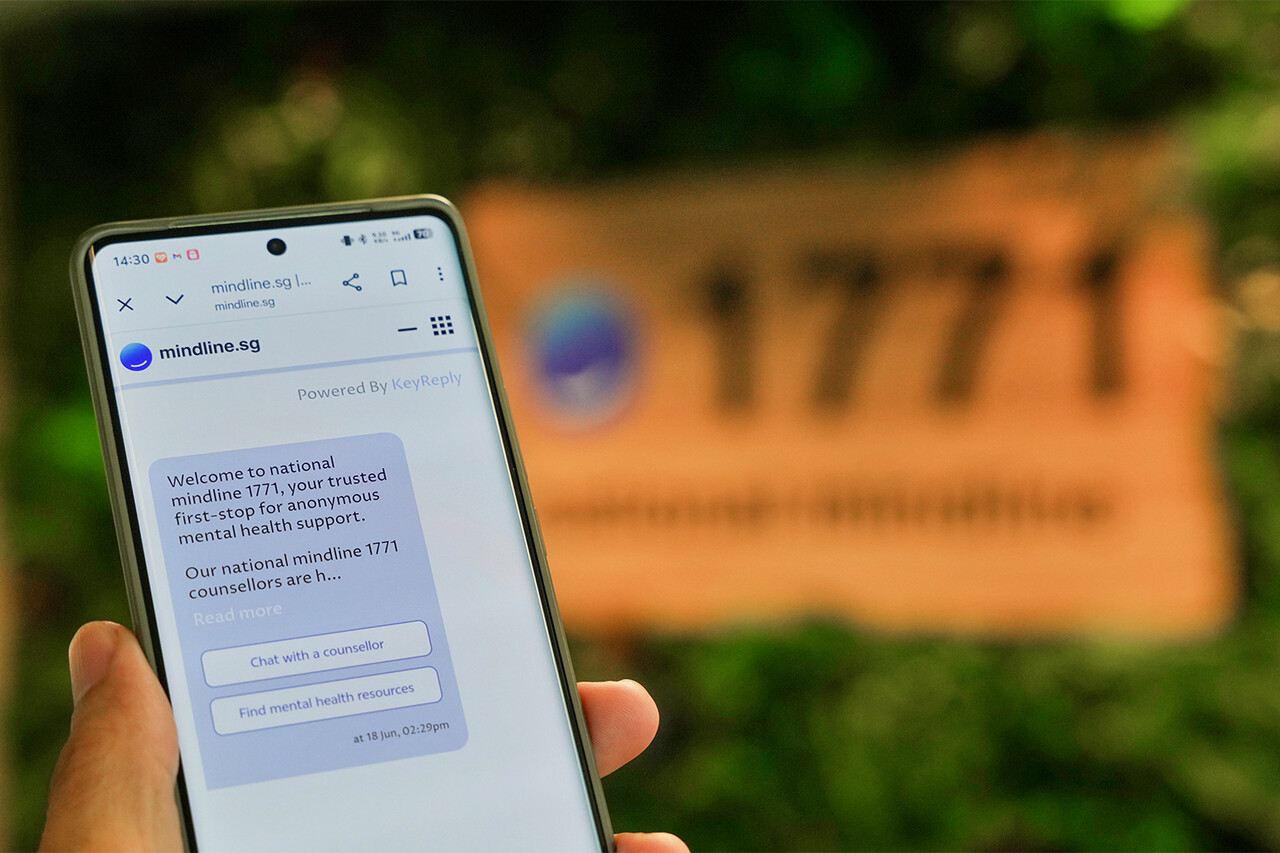
They also address mental health queries, share coping strategies or connect help-seekers to appropriate community services or resources. Launched in June 2025 by the Ministry of Health and operated by trained counsellors from the Institute of Mental Health (IMH), national mindline 1771 is a crucial first stop for those seeking mental health support, especially if they prefer speaking to a counsellor over the phone or via text message.
Help-seekers can choose to remain anonymous. Roughly one in four individuals who have contacted national mindline 1771 and chose to reveal their age are younger than 20 years old.

Many of the help-seekers Calvin speaks with are teenagers navigating independence who fear being judged by their peers or hesitate to open up to adults. The issues they raise range from bullying and exam stress to friendship conflicts and parental expectations.

Dr Christopher Cheok, programme director of national mindline 1771 and senior consultant at IMH, says that younger children may hesitate to share their concerns, especially if they feel that their parents are busy with work or other commitments.

"Some parents may be emotionally unavailable due to personal struggles, such as marital difficulties, which can make children hesitant to add to what they perceive as existing family stress," he says.

Young people are not the only ones reaching out for help. Adults also turn to the service when the pressures of work, parenting or caring for ageing parents begin to feel overwhelming.

One woman reached out while caring for an elderly parent with cancer, as sleepless nights and the constant worry of caregiving had begun to take a toll. After listening and talking through her situation, the counsellor connected her with a community partner for longer-term counselling and support.

Such calls are not uncommon, says Dr Cheok, noting that caregivers often juggle multiple responsibilities like medical appointments and clinic visits alongside work and family duties.

"These may create stress, particularly when they conflict with work obligations or family time. Caring for loved ones with cognitive decline, such as dementia, brings emotional challenges including helplessness, grief and frustration."

Barriers to seeking help can include thinking that mental health challenges are something to be endured, not knowing where to find support, or assuming that no one can help, he adds. But seeking help is not a sign of weakness.

Another national mindline 1771 counsellor Idris Othman* says some callers reach out in the midst of panic attacks.

"You hear them hyperventilating, sobbing, expressing distress. I guide them through breathing exercises and by the end of the call, they are calmer, sometimes even laughing out of relief," he says.

At the end of the conversation, counsellors may also guide help-seekers towards appropriate mental health support services based on their needs.

Idris adds: "Some help-seekers tell me they didn't realise this kind of help exists, and that there are organisations they can reach out to. It's a privilege for me to be there for them as they navigate their challenges. I'm glad they have an avenue to share their worries and be heard."

**Counsellors are identified by the pen names they use during conversations.*

=====

*"Even if someone shares something shocking, we remind them: 'I'm not here to judge you'."*

---- Calvin Lin*, a full-time counsellor at national mindline 1771

=====

----------

早安 2026-04-22

全国心理援助服务1771:匿名求助 随时找人倾诉 national mindline 1771

*全国心理援助服务1771:匿名求助 随时找人倾诉*

本文由心理卫生学院呈献

https://www.zaobao.com.sg/lifestyle/health/story20260420-8727997?utm_source=android-share&utm_medium=app

2026-04-20

全国心理援助服务1771(national mindline 1771)是一项全天候开放的心理支援服务,为任何需要情绪支持的人提供倾诉与求助的渠道。对许多来电者来说,尤其是面对孤独、人生转折或照护压力的年长者与照护者,这通电话往往是迈出求助的第一步。


不只是倾听 也为求助者指路

“哈喽,你吃了吗?”“我已经吃药了。”

这是其中一名经常来电者的通话内容,汇报着每天的琐事。电话另一端的全国心理援助服务1771接线辅导员陈丽丽(化名)发现,这类来电往往有一个共通点——谈的不是大问题,而是从吃饭、服药到日常作息等生活起居事项。

丽丽观察道:“许多年长来电者其实并没有说自己遇到什么问题。他们谈的往往是日常小事。对旁人来说可能很琐碎,但对来电者来说,这意味着有人在凝听与关心。”

全国心理援助服务1771由保健卫生部设立,心理卫生学院负责管理,全天候提供服务。这是我国首个全国心理健康援助热线和短信服务。


热线辅导员经常接到年长者来电,诉说他们在生活转折、健康或经济焦虑,以及孤独感中的情绪压力。

对一些来电者而言,这通电话不只是一次倾诉,也可能成为寻求帮助的起点。辅导员会先了解和评估来电者的需求,再引导他们寻求适当的支援与资源。

乐龄来电揭露3个常见困扰

自2025年6月启用以来,这项服务已处理超过3万9000通电话、短信和线上对话。团队中有超过20名能以华语沟通的辅导员。

丽丽说,自己从小与祖父母关系亲近,这让她在与年长者沟通时更容易建立信任感。许多来电者其实只是希望有人愿意听他们说说话。

全国心理援助服务1771有超过20名能以华语沟通的辅导员。(档案照)

她说,从这些来电中,可以看到年长拨电者面对的三类常见困扰:

一、孤独感


“他们不会直接说自己很孤单,但你能感觉得到。”丽丽分享道。这通常可以从来电频率和谈话内容中推断出来。

她表示:“其实,他们只是希望有人回应。”

面对这样的来电,辅导员往往会分享一些简单的自我照顾贴士,例如每天散步、维持均衡饮食等。

二、围绕经济状况与健康的焦虑


一些来电者担心找不到工作,也为医疗费用感到忧虑。

辅导员会向他们提供相关资源,例如转介至社区关怀计划(ComCare)以获取临时经济援助,或转介至医务社工、劳动力发展局等机构,帮助他们寻找工作或获得支持。

三、失去生活目标


“我现在好像也没有什么计划了。生活无聊,......或许看看电视吧。”一名退休来电者这样说道。

离开职场后,一些人因生活失去节奏而感到迷失。辅导员会建议他们立下一些可行的小目标,如建立日常作息规律,或是参与社区活动,以便重新找回生活规律与意义。比如,若是来电者愿意分享他们的邮区号码,辅导员可以帮忙查找他们住家附近的活跃乐龄中心在哪里,以便他们能就近参与活动,扩大社交圈,减少孤独感。。

“孤独是一个复杂的问题。年长者一旦社交少,容易感到生活没有目标、与社会脱节。”——全国心理援助服务1771项目主任兼心理卫生学院高级精神科顾问石清顺医生

热线与短信服务 成第一联系点

石清顺医生说:“有需要时,寻求帮助并不代表软弱,因为你无需独自面对。” (档案照)

对一些来电者而言,这通电话除了提供倾诉的空间,也可能成为连接外部支援的重要一步。这项服务为不知从何求助的人提供匿名情绪支持,并引导他们联系相关服务。

全国心理援助服务1771项目主任兼心理卫生学院高级精神科顾问石清顺医生说:“这些来电反映的是情绪压力,或许还不到需要立刻进行危机干预的程度,却应该受到重视。”


他指出:“孤独是一个复杂的问题。年长者一旦社交少,容易感到生活没有目标、与社会脱节。随着年老力衰,他们更容易变得焦虑和缺乏安全感。”

石医生说,抑郁症是更严重的情况,可能表现为失眠、食欲下降、容易烦躁、出现轻生念头,或感到绝望。

他建议在日常生活中,家人可以通过与年长者保持联系来提供支持,例如多探访长辈、一起活动,或鼓励长者参与社区活动。

他强调:“有需要时,寻求帮助并不代表软弱。你无需独自面对。”

照护者感无助 如何应对?

“我父亲不愿配合,我连他的床单都换不了。”“我真的不知道还能做什么。”“我很累了。”

不少照顾年迈家人或患病父母的照护者,往往在长期承受身心压力后才拨打热线。

有来电者曾反映说:“兄弟姐妹只给钱,但所有事情都是我在做。”

丽丽说:“这些照护者往往只是需要一个安全的空间,把累积的负面情绪抒发出来。”她发现,这类对话中,来电者常常会叹气。

辅导员的角色不是告诉他们应该怎么做,而是先带着同理心倾听,帮助来电者了解自己的感受、梳理自己的想法。在适当情况下,也会提供一些实际支援选项,例如转介至家庭服务中心(Family Service Centre)或社区援助计划,以获得情绪或经济方面的支持。

引导家长与孩子沟通

除了拨电, 你也可以通过WhatsApp发短信联系全国心理援助服务1771。图为网页聊天服务。(档案照)

全国心理援助服务1771服务所有年龄层,来电者年龄从6岁到89岁不等。

来电者包括:

  • 年长者
  • 照护者
  • 青少年(学生、职场新人)
  • 在职人士

其中在职人士面对沉重工作量、紧迫期限、长期加班、负面的职场环境或工作不稳定等压力。

丽丽举例说,儿童打来的电话,谈及的往往是与父母之间的关系,而不是学业或朋友间的问题。

她回忆起一次印象深刻的来电:一名母亲致电求助,因为孩子难以适应新的学校环境。通话过程中,母亲将电话调至免提,让孩子也能直接参与谈话。

辅导员在过程中引导双方有效沟通,让他们能开诚布公地表达想法,进而讨论如何应对,让这通电话成为一次有建设性的亲子对话契机。

丽丽说:“这份工作让我觉得很有意义。当来电者说‘谢谢你,我真的需要找个人说说话’时,我就会再次确认自己为什么坚持做这份工作。”

全国心理援助服务1771 提供怎么样的援助?

全国心理援助服务1771全天候开放,为有需要的人提供一个让人安心表达的倾诉空间。


有需要时,可拨打1771*,或从WhatsApp发短信到66691771,以匿名方式,寻求情绪上的支持与资讯。

*此服务免费提供,但可能须承担电讯商的一般通话费用。


【本文由心理卫生学院呈献】


Video 晚年健康由七十岁决定


Tuesday, April 21, 2026

Anthropic’s Mythos is a warning shot. Singapore’s banking system needs to be ready*

*Anthropic’s Mythos is a warning shot. Singapore’s banking system needs to be ready*

For subscribers 

https://www.straitstimes.com/opinion/anthropics-mythos-is-a-warning-shot-singapores-banking-system-needs-to-be-ready

2026-04-21

By--- Lin William Cong is President’s Chair Professor of Finance, Computing and Data Science at Nanyang Technological University, Singapore, where he serves as the associate dean of Nanyang Business School and is also the founding director of the Global Institute for Finance, Technology, and Society.

=====

When the US Treasury Secretary and the chair of the Federal Reserve convene an unscheduled meeting with Wall Street’s most senior executives, markets pay attention.

And when the catalyst is not a liquidity crisis or a sovereign default, but the capabilities of an artificial intelligence model that its own maker considers too dangerous to release publicly, the rest of the world’s financial centres should pay attention too.

On April 15, the Cyber Security Agency of Singapore issued an advisory to local organisations, urging them to strengthen their cybersecurity measures and patch critical vulnerabilities.

The model in question is Claude Mythos Preview, announced by Anthropic in early April. The company says Mythos has discovered vulnerabilities in major browsers and operating systems, including weaknesses in foundational digital infrastructure. Rather than release the model broadly, Anthropic is reportedly offering it first to major technology and infrastructure firms so they can patch their systems before adversaries acquire similar capabilities.

Reasonable people can debate whether Anthropic is overstating what Mythos can do. The company plainly has incentives to dramatise its own products. But for policymakers, the key issue is not whether every claim about this model is fully proven, but that the possibility was taken seriously by government officials and major financial institutions.

This tells us something important: frontier AI is no longer just a story about productivity tools or consumer applications. It is becoming a question of critical infrastructure, cyber resilience and, potentially, financial stability.

A different class of threat

As a major financial hub and a regional base for global banks, Singapore needs to act early as it would not be insulated from a serious AI-driven cyber incident affecting international finance.

If more powerful AI tools make it easier to find software weaknesses, automate attacks or exploit common digital systems used by many organisations, the effects will not stop at banks or regulators. They could reach the public in ordinary but increasingly costly ways.

In Singapore, phishing scams involving fake DBS and POSB e-mails were reported in 2026, with at least 72 cases and losses of some $484,000. Already, scams led to $913 million in losses in Singapore in 2025. AI could make such attacks even more convincing, allowing criminals to mimic bank alerts, tailor scam messages and imitate the authorities with far greater realism.

In a more serious scenario, a cyberattack on shared digital infrastructure could delay digital payments or disrupt access to banking services. Trust in finance is built in everyday transactions such as when a person expects a salary to arrive on time, a card payment to go through, or a banking app to open safely.

To its credit, the Monetary Authority of Singapore (MAS) has been among the more forward-looking regulators on AI governance. It has introduced frameworks to guide the responsible use of AI in finance, including the FEAT principles on fairness, ethics, accountability and transparency, and the Veritas initiative, which helps financial institutions test and assess their AI systems.

Recent efforts like Project MindForge show that Singapore is also beginning to grapple with newer and more complex AI risks, so the nation is not starting from scratch. But the Mythos episode suggests that the next gap may lie elsewhere.

Much of the existing policy framework, in Singapore and globally, has focused on how financial institutions use AI internally: model risk, fairness, explainability, and accountability. Those remain important concerns. Yet different threat vectors are now emerging: increasingly capable AI systems or AI agents developed outside the traditional financial sector, but potentially deployable against it.

Banks and regulators already invest heavily in cybersecurity, but much of their defensive architecture has been built around known vulnerabilities, known signatures and adversaries operating within relatively familiar bounds.

An AI system that can autonomously discover previously unknown weaknesses in widely used software represents a more demanding class of threat, especially in a financial system built on shared cloud, software and communications infrastructure.

More On This Topic

White House and Anthropic CEO discuss working together amid rising fear about Mythos model

IMF chief warns global monetary system not ready for AI cyberthreats

The challenge becomes sharper as finance itself becomes more automated. Stablecoins, tokenised assets, digital payment rails and software-mediated financial intermediation are expanding the role of code, automation and machine-speed execution.

As autonomous AI agents increasingly participate in trading, treasury operations and on-chain finance, the speed of both innovation and disruption rises, while advances in quantum computing could over time threaten the cryptography that underpins digital finance.

In such an environment, a vulnerability may not remain an isolated technical flaw. It can become a system-level event. That is why the next stage of financial governance cannot rely only on more rules or better compliance. It also requires better ways to test what could happen before a real crisis occurs.

Beyond a siloed strategy

This is where what I call economic world models come in. These are simulation tools that go beyond testing a single bank’s defences. They model how markets, institutions and people actually behave – how a shock at one firm spreads to others, how customers react when a payment app goes down, how attackers and defenders change tactics as incentives shift.

Think of it as a flight simulator for the financial system: a safe environment to rehearse crises before they happen. This matters because financial shocks do not unfold like a machine part snapping without warning. They spread more like panic in a crowd, through watching, reacting and adjusting, and conventional cyber testing was not designed to capture that.

Such tools have already been developed in prototypes at Nanyang Technological University, and Singapore is well placed to develop them further.

A practical next step would be for MAS and its partners to use market-scale and agent-based simulations for risk monitoring and stress tests that go beyond today’s cyber exercises, which focus mainly on whether a single firm can recover from a defined attack.

The bigger question now is how disruption would ripple through payment rails, settlement systems such as MEPS+ and FAST, and the many regional banks and corporates that route transactions through Singapore.

That matters because Singapore is not just another domestic market. It is a regional treasury, payments and clearing hub.

MAS has described it as one of the world’s top offshore renminbi centres, and DBS joined ICBC Singapore as an RMB clearing bank in December 2025. A serious disruption here could therefore spread well beyond Singapore into the wider region’s trade and settlement flows.

AI-driven shocks will not stop at borders and Singapore is in an ideal position to convene an open, cross-border simulation platform, bringing together banks, regulators, researchers and technology providers across the region to share scenarios and stress-test them together.

In an AI era, watching for system-wide risks can no longer be siloed within each country.

Even then, Singapore should build its own AI capability in this space rather than rely entirely on foreign-built systems.

More On This Topic

With AI, cyberattacks come fast; it’s time firms patch faster

Cyberdefenders urged to use AI to counter AI threats

Local universities and research institutes already have strong foundations in AI and financial modelling. Multilingual AI models, scenario sandboxes and digital twins of the financial system should become part of the country’s core governance infrastructure, as essential as its physical infrastructure.

None of this requires accepting the most alarmist reading of what Mythos can do today. Healthy scepticism is entirely appropriate. But prudent governance does not wait for the worst case to be conclusively established. It responds when the direction of risk becomes clear.

AI capability is beginning to intersect with financial infrastructure in ways that may be faster, more adaptive and harder to contain than before.

For Singapore, the question is not only how banks should use AI responsibly, but how the country should prepare for a world in which more powerful AI may be used to test, probe or disrupt the systems that people rely on every day.

That may sound abstract until something goes wrong. Then it becomes concrete very quickly. It could be a salary that does not arrive on time, a transfer that cannot be made, a bank account that has been compromised, or a customer who no longer trusts what appears on their mobile screen.

In that sense, preparing for AI-related financial risk is not just a technical exercise or a regulatory concern. It is part of protecting the reliability on which modern economic life depends.

Lin William Cong is President’s Chair Professor of Finance, Computing and Data Science at Nanyang Technological University, Singapore, where he serves as the associate dean of Nanyang Business School and is also the founding director of the Global Institute for Finance, Technology, and Society.

ACP: As more Singaporeans age with smaller families, end-of-life planning must evolve*

*As more Singaporeans age with smaller families, end-of-life planning must evolve*

For subscribers 

https://www.straitstimes.com/opinion/as-more-singaporeans-age-with-smaller-families-end-of-life-planning-must-evolve

By--- Bussarawan Teerawichitchainan is an associate professor of sociology at the Faculty of Arts and Social Sciences, National University of Singapore, and a 2025-2026 Fellow at the Center for Advanced Study in the Behavioral Sciences, Stanford University

=====

When Emily (not her real name), a healthy woman in her mid-50s, chose end-of-life planning, she was not motivated by fear. It was foresight. She had watched a family member endure prolonged medical uncertainty without clear instructions. Without children of her own and never having married, she wanted to ensure that her values and wishes would be known.

Planning early, she felt, was a way of taking responsibility – both for herself and for those who might one day have to speak on her behalf.

Emily’s story is not unusual. As families shrink and childlessness rises, more Singaporeans will reach later life without spouses or children who can advocate for them during medical crises.

Advance Care Planning (ACP) allows healthy individuals to record their healthcare preferences. For instance, they may wish to receive life-sustaining treatment such as resuscitation. The individual can designate someone to speak for them if they lose mental capacity, typically through facilitated discussions with trained professionals and formal documentation, with some options also available through the recently launched online myACP platform.

However, while Singapore has been at the forefront in Asia in promoting ACP, the system and norms still largely assume that family members will play a central role. As family structures evolve, planning systems must adapt as well.

Ageing without close kin

Much of Singapore’s demographic conversation understandably centres on the country’s persistently low fertility rate and how policies might encourage marriage and childbearing.

Yet demographic change is also reshaping the other end of the life course. About 15 per cent of Singaporeans aged 60 and older are childless, and among women born in the early 1970s, roughly one in four remains childless – placing Singapore among countries with the highest levels of permanent childlessness.

Many have never married and may be ageing without close kin. As families become smaller, more Singaporeans will move into older age with fewer relatives to rely on for support or decision-making.

In a nationwide study of Singaporeans aged 50 and above, my colleagues and I found that childless Singaporeans are often more proactive in end-of-life planning than those with children. Childless individuals in our sample were more likely than parents to have initiated either formal documentation or informal discussions about their end-of-life preferences.

Childless women stood out in particular. They were the most likely to engage in planning – through conversations, formal documentation, or both. Many described motivations rooted in lived experience: having witnessed family crises, having cared for ageing parents, or wanting to avoid burdening siblings and relatives. Like Emily, they often saw such planning as part of a broader ethic of responsibility and self-reliance.

Planning patterns among childless men were more mixed. While some were proactive, others felt little urgency or cited financial strain. These differences partly reflect broader life course pathways to childlessness in Singapore, where women’s childlessness is more often linked to partnership patterns such as delayed and forgone marriage, while men’s childlessness is more closely associated with economic disadvantage.

No one to speak for them

Importantly, the study also highlights barriers that extend beyond individual motivation. A recurring challenge for childless individuals was the difficulty of identifying a trusted proxy decision-maker.

Some hesitated to appoint siblings who were close in age. Others were reluctant to rely fully on friends, reflecting the enduring cultural preference for kin-based decision-making.

Misunderstandings about ACP further complicated matters. Some childless individuals conflated ACP with costly legal procedures, or assumed it was relevant only for the wealthy or the seriously ill. Others associated it primarily with decisions about withdrawing life support, rather than understanding it as an ongoing conversation about values, preferences and care goals.

Such perceptions can discourage engagement or lead to partial planning, where documentation is completed without discussion, or vice versa.

These findings suggest that as family structures evolve, ACP frameworks must evolve as well. The goal is not simply to increase uptake, but to ensure that planning processes are inclusive and responsive to diverse family realities.

More On This Topic

Majority confident but less than a quarter on track: The retirement planning gap Singaporeans need to close
Father, daughter deaths in Sengkang flat: Who will look after the vulnerable when caregivers die?

How frameworks can be improved

Start conversations about what you want your end-of-life care to look like while you’re healthy, not just when you’re in crisis. Weaving these discussions into regular doctor visits and community programmes could change how people see them.

People sometimes confuse ACP with complicated legal documents and worry it will cost a fortune. Clear public messaging should explain what it actually is – a straightforward, supported conversation. That alone could ease a lot of unnecessary anxiety.

Many people find choosing someone outside the family to make decisions on their behalf difficult, especially those without close family. Better guidance and stronger protections are needed to ensure these preferences are recognised and acted upon.

As more adults find themselves without traditional family support, helping them find trusted decision-makers will matter more than ever.

Men and people balancing caregiving responsibilities with other demands often don’t think about long-term planning in the same way others do. Reaching them through workplaces and community groups – tailored to their circumstances – could bring them into these conversations.

ACP is not about dwelling on death. It is about ensuring that one’s voice is heard at moments when one cannot speak for oneself.

As Singapore advances its vision of ageing well, preparing for end-of-life care must reflect the realities of smaller families, shrinking kin networks and more diverse living arrangements.

Making ACP work for everyone matters. It’s about respecting people and giving them real clarity about what comes next.

Bussarawan Teerawichitchainan is an associate professor of sociology at the Faculty of Arts and Social Sciences, National University of Singapore, and a 2025-2026 Fellow at the Center for Advanced Study in the Behavioral Sciences, Stanford University.

More On This Topic

The move away from concierge care in private hospitals has begun

Who cares for caregivers? 10 agencies get new grant to expand support, respite care in S’pore

ACP: New digital tool in Singapore to encourage advance care planning 2025-07-19

New digital tool in Singapore to encourage advance care planning  
  
https://www.straitstimes.com/singapore/health/new-digital-tool-in-singapore-to-encourage-advance-care-planning

2025-07-19

======

SINGAPORE – A free digital tool that makes it easier for Singaporeans to complete their advance care plans (ACP) online was launched on July 19.

Called myACP, the tool allows users to document their preferences for medical treatment in advance, in line with their personal goals and values.

They can also designate someone to make healthcare decisions on their behalf if they become mentally incapacitated.

The digital tool was launched by the Ministry of Health, Agency for Integrated Care and GovTech at Heartbeat@Bedok.

Speaking at the launch, Health Minister Ong Ye Kung said the tool eliminates the need to meet an ACP facilitator in person.

Anyone who is generally healthy and is at least 21 years old can document their care preferences and submit them online.

Mr Ong said common reasons for not completing ACPs include a lack of knowledge of the process and the inconvenience of making an appointment with a facilitator – a time-consuming step that may also involve fees.

Previously, individuals had to visit public hospitals, polyclinics or certain social care providers to make such plans.

Now, they also have the option of using the new tool, found on the My Legacy@LifeSG platform at https://mylegacy.life.gov.sg

(From left) CPF Board Retirement Income Group director Gregory Chia, Ministry of Social and Family Development Family Life Group senior director Tan Chee Hau, Health Minister Ong Ye Kung, Public Service Division ServiceSG CEO Lim Sze Ling and Agency for Integrated Care CEO Tan Chee Wee at the myACP launch on July 19. ST PHOTO: AZMI ATHNI

It takes about 30 minutes to complete an ACP. Users will have to indicate their preferences on hygiene, companionship and religious requirements, as well as make a decision on whether doctors should prioritise comfort or carry out life-sustaining treatments, among other matters, Mr Ong said.

But those with existing illnesses, such as cancer or heart failure, will still need to complete their ACP with the help of their healthcare team or a certified facilitator.

At present, about 77,000 people have completed their ACP, Mr Ong said.

“This is 40 per cent higher than the national figure as at last year, but it’s still very small a number,” he added.

Mr Ong said the authorities are trying to encourage more Singaporeans to plan ahead. 

While some people have preferences for end-of-life care, most are reluctant to broach the subject with their loved ones while they are healthy as it is considered pantang, or taboo, according to the minister.

“It will be too late to do so when they have fallen very sick and cannot communicate what they want to their loved ones. Family members and doctors are then placed in a difficult position to decide on the care approach,” he said, noting that different opinions can escalate into family disputes.

“We need more open and early conversations about future care needs... When we plan ahead, we not only safeguard our own preferences, we also make things easier and clearer for families and healthcare teams later on.”

In 2023, the Government launched the National Strategy for Palliative Care to raise awareness about end-of-life issues amid an ageing population.

Since then, palliative care capacity has been expanded, rising to 3,000 home care places and 300 inpatient hospice beds currently from the 2,400 care places and 260 beds in 2023, Mr Ong said.

Palliative care competency was also strengthened, with 62 – or about two-thirds – of nursing homes in Singapore establishing partnerships with hospitals. 

This means that when a nursing home resident is approaching his end of life, he will remain in the facility instead of being unnecessarily transferred to a hospital.

Mr Ong noted that the efforts by the authorities have started to show results.

In 2022 and 2023, 62.5 per cent of deaths happened in hospitals. This dropped to 59.8 per cent in 2024.

“While this appears to be a small improvement, it translates into thousands of patients having their wishes fulfilled. Attitudes take time to change, and we are encouraged to be heading in the right direction,” he said.

Ms Clara Ng, 56, who completed her ACP online last week, said she decided to do so to be prepared for the future.

“I’m still at the stage where I have the capacity to think. It’s good to log down what I want rather than wait till it’s too late,” said Ms Ng, who is currently completing her master’s course in gerontology.

  • Isabelle Liew is a journalist at The Straits Times. She covers housing issues in Singapore, with a focus on public housing.