Showing posts with label SRS. Show all posts

Sunday, September 1, 2024

Supplementary Retirement Scheme 简称SRS: 更多人通过退休辅助计划投资 18至35岁者是最大存户群


更多人通过退休辅助计划投资 18至35岁者是最大存户群

订户
发布 /
3 小时前
2024-09-01
根据财政部数据,截至去年底,本地有超过42万人参与退休辅助计划,比前一年增加10.3%或3万9811人,存户人数增幅虽然不比前一年高,但总数首次破40万。(档案照片)

字体大小:

越来越多人使用退休辅助计划进行投资,开设这个账户者,年龄也有年轻化的趋势。

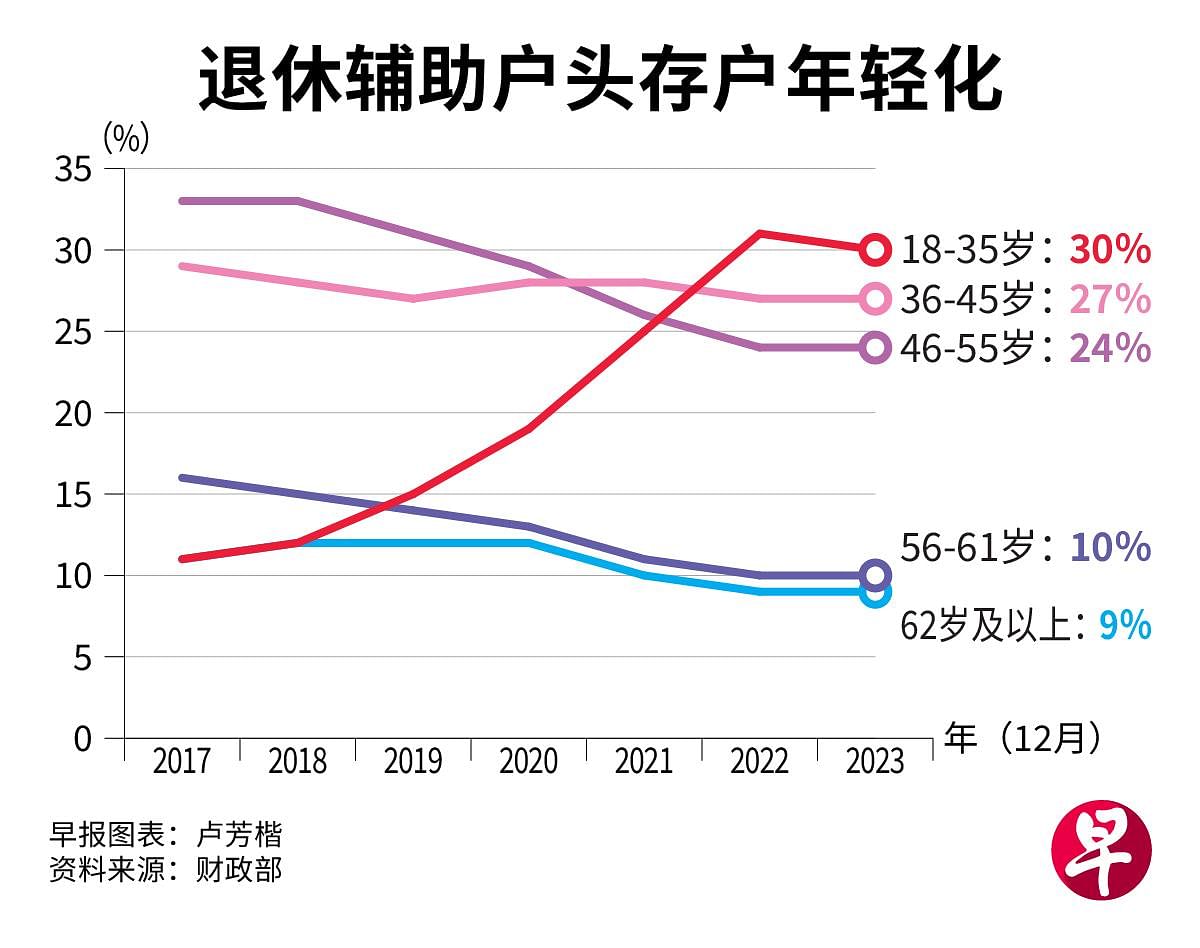
过去三年来,年龄低于46岁的存户,已成为最大的两组存户群,尤其是18岁至35岁者,在2022年和2023年,一跃成为最大存户群,在存户总数中,占了三成。

根据财政部数据,截至去年底,本地有超过42万人参与退休辅助计划(Supplementary Retirement Scheme,简称SRS),比前一年增加10.3%或3万9811人,存户人数增幅虽然不比前一年高,但总数首次破40万。 

存户累计的整体款项,则增长了12.9%或21亿元,达184亿3000万元。

18岁至35岁人士 成为最大存户群

过去,存户多为固定收入较高、房贷车贷等负担较少的中年人士,年龄介于46岁至55岁者的占比是三成或以上。

但这三年来,情况出现变化,年龄介于18岁至35岁者,从原本占比不到两成逐年增加,2022年和2023年取代中年人士,成为最大的存户群。

退休辅助计划是一项自愿性质的退休储蓄计划,与强制性质的公积金计划相辅相成。自2001年推出,以扣税作为优惠,鼓励人们存款入这个账户进行投资,同时为退休作储备。

新加坡人每年可存入最多1万5300元到SRS户头,外籍人士的存款顶限则是3万5700元。若在年底之前存入,次年报税时便可从纳税收入中自动减去存入数额,节省200元到3000元的税款。

刚满34岁的陈佳宇(资讯科技从业员)就是一个例子。他三年前买保险时,采纳保险代理员的建议,开设SRS户头来支付保费,一来避免因收入增加跨入税率更高的税阶,二来是暂时没有婚娶购屋打算,想通过SRS户头购买长期债券。

佘昱龙(36岁,房地产中介)四年前开设SRS户头,存入一笔钱后就决定暂置一旁。“这是我退休财务计划的一环,用来投资股票。但它的流动性有局限,不会成为我主要的理财工具。”

家庭收入增加 公众用SRS省税

辉立证券金融服务经理黄奕明认为,近几年SRS的公众宣导教育加强许多,公众更了解它的目的和好处,存户增多是可以预见的。加上全国家庭月收入中位数,在过去五年内累计增长了10.5%,须缴税的人更多,省税的方法自然引人关注。

数码投资平台Endowus研究主任阿斯特尔姆同意这个观点。他说,近年来,市场上越来越多基金经理推出特别与SRS挂钩的投资产品,像一些线上的指数基金,使投资产品更多元化,这对较年轻的投资者来说,更具吸引力。

本地理财视频制作者罗清全认为,SRS是相对复杂的税务延递机制,尽管新加坡人的薪水逐年增加,但许多人缴税不高,因此不觉得SRS有多大好处,兴趣也不大,所以相对于公积金户头,SRS存户还是不多。罗清全是推动在65岁时积累100万元公积金存款的1M65运动创始人。

以部分时间工作的何艾莉(72岁)2002年就开设SRS户头,她每年定期存入最高数额,以减少缴税。“我一年可以省下600多元的税,而且SRS的钱用来买附带投资的保险产品,有投资回报和保障,是划算的。不过,那些要还房贷的人,还是把钱用来快快还清贷款,房贷的利息比扣税更高。”

SRS户头的存款,可在法定退休年龄后在10年内提取,每次取款,只有一半要缴税。未达退休年龄提款,则须全额计入所得来缴税。

LIKE我们的官方脸书网页以获取更多新信息

更多精彩内容

Pantry News Talk
Lianhe Zaobao Club


Sunday, December 24, 2023

CPF and SRS dos and don’ts for the year end of 2023

×
The Straits TimesSPH Media Limited
INSTALL

In The Money

CPF and SRS dos and don’ts for the year end

This fortnightly column addresses readers’ investing issues.

Investment involves risk. Past performance is not necessarily a guide to future performance or returns. PHOTO ILLUSTRATION: PIXABAY

Q: It’s nearly the end of the year. If I haven’t done anything on the Central Provident Fund or Supplementary Retirement Scheme (SRS) front, are there any tips on what I should do?

Central Provident Fund is a key area of your finances that should not be neglected. Topping up the various accounts will boost your retirement funds and give you some tax relief. CPF is an effective instrument to reap the benefits of compounding over the long run, says DBS Bank head of financial planning literacy Lorna Tan. 

Interest rates on the various CPF accounts have not changed, even though interest rates in general have been rising.

The CPF Board said last week that “the Government is watching the interest rate environment closely to ensure that the CPF interest rate pegs remain relevant in the prevailing operating environment while taking into consideration the longer-term outlook”.

Tip 1: Top up your CPF accounts

Below 55 years of age: top up CPF Special Account (SA)

Top up your retirement funds by contributing to the SA. The limit is the current Full Retirement Sum (FRS) less the sum of SA and the amount withdrawn from SA for investment. 

Assume you have $80,000 in the SA comprising $40,000 cash and $40,000 in unit trusts. As the FRS is $192,000 this year, this means that you can top up your SA by $112,000 ($192,000 minus $80,000).

Get tips to grow your money and career

By signing up, you agree to our Privacy Policy and T&Cs.

Above 55 years of age and topping up of Retirement Account (RA)

Your RA is created when you hit 55. The top-up limit is the Enhanced Retirement Sum ($288,000 this year) less RA savings. 

As an illustration, under the CPF Life Standard Plan, if you have the Full Retirement Sum of $192,000 in your RA by 55, you will be able to receive a monthly payout of between $1,470 and $1,570 from 65.

If you top up your RA to the current maximum of $288,000, you could get the higher monthly payouts of an estimated $2,140 to $2,300 via CPF Life when you reach 65.

Topping up of MediSave Account (MA)

You can top up your MA up to the Basic Healthcare Sum (BHS), which is $66,000 this year. CPF has just announced that the BHS will be $68,500 next year.

Tip 2: Enjoy tax relief on your topping-up sums

Topping-up your own CPF accounts

You get to enjoy tax relief of up to $8,000 (previously $7,000) per calendar year when you top up your SA, RA and/or MA. 

Do note that there is no tax relief when you top-up your RA beyond the Full Retirement Sum, said PhillipCapital financial services manager Elijah Lee.

Topping-up of loved ones’ CPF accounts

There is an additional tax relief of up to $8,000 (previously $7,000) when you top up your loved ones’ SA, RA and/or MA. Loved ones could be parents, parents-in-law, grandparents, grandparents-in-law, spouse and siblings.

However, for a spouse or sibling, you will be eligible for the tax relief only if his/her income in the previous year does not exceed $4,000 or if the recipient is handicapped.

Tip 3: Timing of top-up 

DBS’ Ms Tan suggests performing the top-ups at the start of the year to earn more interest.

As CPF interest is computed monthly, topping up your CPF accounts in January rather than December could earn 20 per cent more interest over 10 years.

PhillipCapital’s Mr Lee noted that those whose income is variable may wish to do a one-time top-up closer to the end of the year when they have a better picture of their overall income for the year.
Tip 4: Transfer funds from the CPF Ordinary Account to the SA

This is not necessarily something you need to do before the end of the year, but it is worth considering to maximise the return on your funds. 

Mr Samuel Rhee, chairman and chief investment officer of digital wealth adviser Endowus, suggests that younger CPF members with low CPF SA and MA balances can transfer funds from the OA to SA to enjoy the higher CPF interest rate of 4 per cent a year.

Mr Lee said that for some of his younger clients who have been doing such regular transfers, there is a risk that their OA may end up being insufficient for a downpayment on a property if they have not planned ahead.

“Identify the timing of your property purchases to ensure you will have sufficient OA funds for such big-ticket transactions,” he added.

How to top up your CPF

– Download the CPF forms and fill them up or

– For the CPF mobile app, log in using your Singpass, tap on menu icon and choose “Services”. Choose “Cash Top-up” and indicate the recipient (“Self” or “Loved Ones”), submit your application, and make payment immediately or

– For the CPF website, go to cpf.gov.sg/rstuform and log in using your Singpass. Choose your preferred cash top-up method and top up via PayNow QR, eNETs or via Giro.

What is SRS?

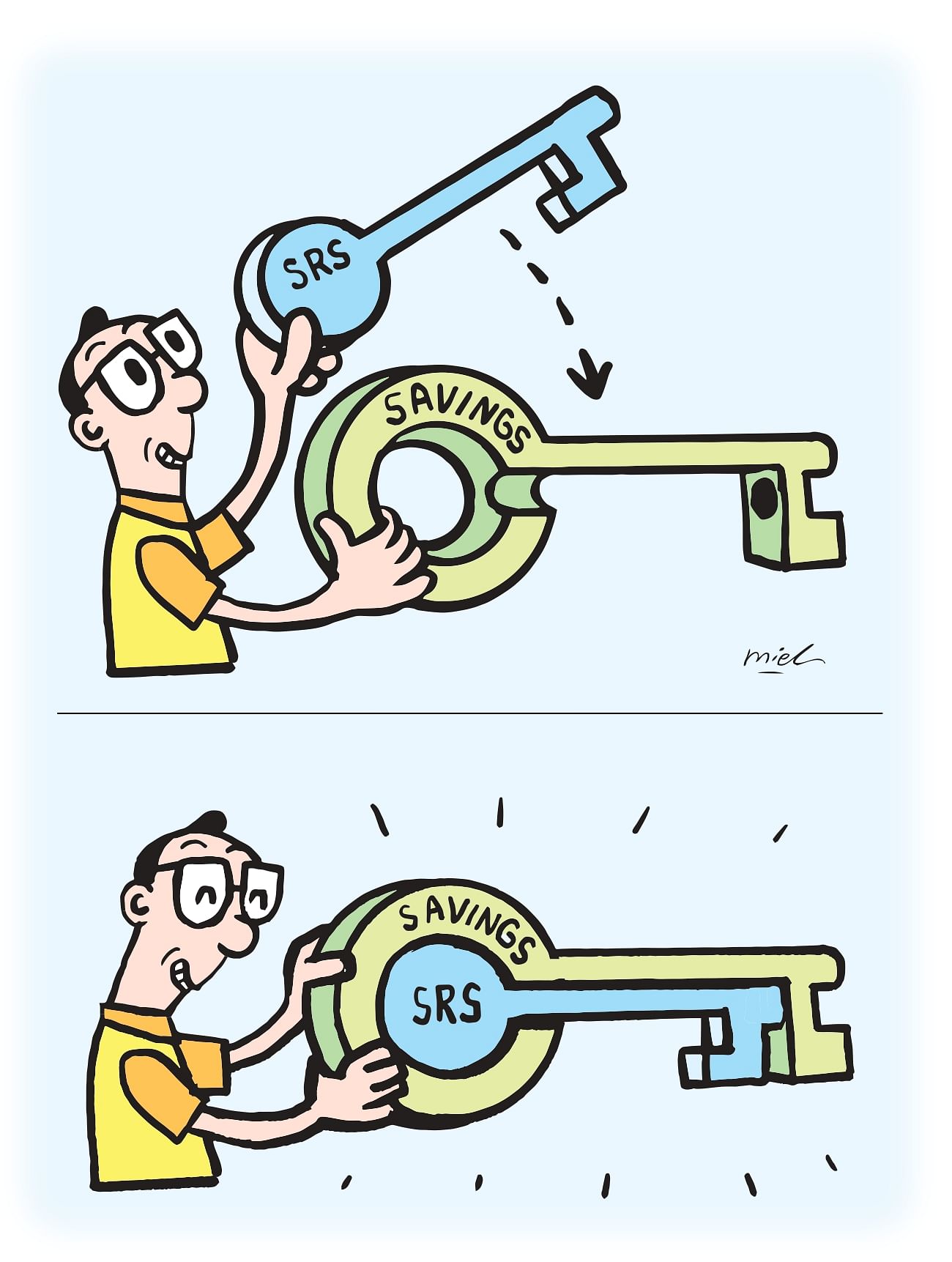
The Supplementary Retirement Scheme (SRS) is a voluntary scheme to encourage individuals to save for retirement and to supplement their CPF savings. It was introduced in 2001.

The yearly maximum SRS contribution from Singapore citizens and permanent residents is $15,300 and $35,700 for foreigners.

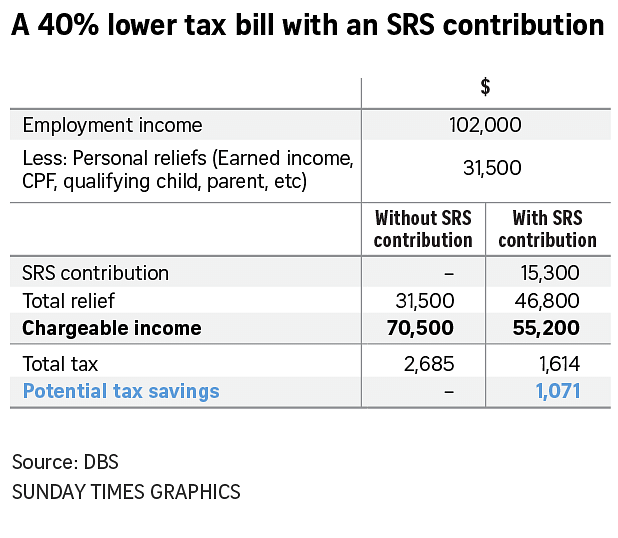
Contributions to SRS are eligible for tax relief. You get a dollar-for-dollar tax relief on your SRS contributions, which reduces your chargeable income.

All SRS contributions must be made by Dec 31 of the year or as your SRS operator requires, to be eligible for SRS tax relief in the following year of assessment, said DBS’ Ms Tan.

See the calculation in the table for how making an SRS contribution for the year can bring down your tax bill.  

Tip 1: Don’t leave funds idle in the SRS account

Ms Tan advises people not to let the cash in the SRS account remain idle after you have moved funds there. The interest paid currently stands at 0.05 per cent per annum.

A significant 24 per cent of total SRS contributions ($14.36 billion), or $3.44 billion, were left idle as at end December 2021, she added.

Funds in the SRS account can be invested in many different types of investment products ranging from fixed deposits, government bonds and securities to insurance, shares and unit trusts.

Applications for Singapore Government Securities bonds and Treasury-bills and the popular Singapore Savings Bonds can be made through the Internet banking portals of your SRS operator (DBS/POSB, OCBC or UOB).

All profits made from investing your SRS contributions will return to your SRS account.

Tip 2: Keep an eye on the tax relief cap

The personal income tax relief cap of $80,000 a year applies.

If a high-income working mother has two children or more, the numbers may not work out for her to contribute to SRS if her Working Mother Child Relief claims are significant, noted PhillipCapital’s Mr Lee.  

Tip 3: Pay attention to the timing of SRS withdrawals

The penalty-free 10-year withdrawal period starts from the statutory retirement age that was prevailing at the time of your first SRS contribution.

Only 50 per cent of withdrawals (post statutory retirement age) are taxable. So, to reduce your tax burden, stagger your withdrawals, advises Ms Tan.

Example:

A Singapore resident has an SRS balance of $400,000. He withdraws $40,000 each year (over 10 years). This means that 50 per cent of that amount, or $20,000, will be taxable each year.

If he has no other source of taxable income, he will not need to pay any income tax as the first $20,000 of total annual income is tax-exempted.

Note that SRS withdrawals need not be in cash. This means being able to hold onto the SRS investments instead of having to liquidate them first before withdrawing them in cash. 

Tip 4: Pay attention to the various fees charged when investing

Instead of setting aside a lump sum once a year, you can make regular monthly transfers to your SRS account up to the annual tax-relief limit. Pay attention to costs such as transaction fees, sales fees or trailer fees when investing, said Endowus’ Mr Rhee.

Bottom line

If you have not done the various top-ups and you are able to spare the funds, do so in order to claim tax relief for the income you have earned this year.

Investment involves risk. Past performance is not necessarily a guide to future performance or returns.

The value of investments and the income from them can go down as well as up, and you may not get back the full amount you invested.

If you are in doubt, you should consult your stockbroker, bank manager, solicitor or other professional advisers.

Join ST's Telegram channel and get the latest breaking news delivered to you.

RECOMMENDED

Pay attention to withdrawal timing from Supplementary Retirement Scheme

×
The Straits TimesSPH Media Limited
INSTALL

Pay attention to withdrawal timing from Supplementary Retirement Scheme

The prescribed retirement age is the one prevailing when you made your first SRS contribution. This is now either 62 or 63. ST PHOTO: GIN TAY

The Supplementary Retirement Scheme (SRS) encourages individuals to save for retirement, over and above their CPF savings. 

Contributions are eligible for tax relief. The maximum contribution by Singapore citizens and permanent residents is $15,300 a year, while foreigners can put in $35,700.

You can withdraw your SRS savings at any time. But if you do so before your prescribed retirement age, all the withdrawn sum will be fully taxed and attract a 5 per cent penalty, based on the withdrawn amount.

The prescribed retirement age is the statutory one prevailing when you made your first SRS contribution. This is now either 62 or 63.

Penalty-free withdrawals can commence at or after the prescribed retirement age. You can make penalty-free withdrawals from your SRS account over 10 years, starting from the date of your first penalty-free withdrawal. During this period, only half of your SRS withdrawals will be subject to tax.

Mr Elijah Lee, senior financial services manager at PhillipCapital, has outlined five tips to help Sunday Times readers get the most out of their SRS accounts.

1. Aim to align the payout period of your policies with the penalty-free, 10-year withdrawal period

Buying an annuity or endowment with SRS funds is not uncommon. When it comes to such term annuities or endowments, the taxman assumes the term annuity is liquidated at the end of the 10-year penalty-free withdrawal period. 

Get tips to grow your money and career

By signing up, you agree to our Privacy Policy and T&Cs.

The surrender value of the policy at the end of the 10th year of SRS withdrawal will be deemed to be withdrawn and 50 per cent will be subject to tax. 

There will be no further tax after the end of the 10-year withdrawal period even if you continue to receive payments from a term annuity.

If you need funds after the 10 years and want to surrender the term annuity, you may approach the product provider.

For life annuities, payouts will continue to be made until the product owner dies.

If the payouts started before or during the 10-year withdrawal period, they are paid into the SRS account. Only half of the SRS withdrawals made during this period will be subject to tax.

Once the 10-year withdrawal period ends, the life annuity payout will be paid directly to the SRS member and 50 per cent of the life annuity payout will continue to be taxed.

Mr Lee says: “Ideally, time the withdrawals of your term annuity or endowment to start during the 10-year withdrawal period to minimise the tax. Even if the payouts continue after the 10-year period, your taxable income should be lower by then and attract less tax.”

2. Time your withdrawal period to coincide with the start of retirement

If you have already opened an SRS account and made your first contribution, any subsequent change in the statutory retirement age will not affect you.

There is no specific period on when the penalty-free withdrawal must commence for withdrawals on or after the prescribed retirement age. 

However, the 10th year will be counted from the date of the first penalty-free withdrawal. For example, if you start withdrawing when you are 72, the 10-year period will be from 72 to 81 years old.

People who work for longer can save tax if they begin their 10-year withdrawal period at a later age when they have fully retired and are no longer earning.

Mr Lee notes: “As some people may be working longer past their prescribed retirement age, they can consider commencing their withdrawal period later.” 

3. Withdraw investments during market lows 

If you have investments, including stocks, in your SRS account, the same practice applies – only half the value of the withdrawals will be taxed during the 10-year period. 

Previously, investments had to be sold and the funds transferred out as cash. But since 2015, SRS members can apply to have the investments withdrawn and transferred out of the account, without having to liquidate them. 

The valuation is based on when the withdrawal is made. 

If the intent is to hold on to these investments for the long term, one way of optimising withdrawals is to time them during market lows as their relatively lower valuation will attract less tax, advises Mr Lee. 

4. Remember your other sources of taxable income such as rental income

Mr Lee notes that there may be other sources of taxable income, such as investment properties generating rental income. These should be taken into consideration when planning for withdrawals. 

Take for example a 65-year-old retiree who has decided to start his 10-year withdrawal period. At the same time, he is receiving annual rental income of $60,000 from an investment property. This income is subject to income tax. 

Although only 50 per cent of the SRS withdrawal sum is subject to tax, this will increase his tax bill as he already has to account for the rental income.

Mr Lee says SRS members will have to take such sources of income into consideration when planning how best to manage their investment portfolio during retirement. They should consider how long they want to keep the investment property or if they want to defer the withdrawal period to when they no longer have such taxable income. 

5. Deploy your SRS funds

Many people leave their funds in their SRS account, where they only earn 0.05 per cent interest.

Mr Lee encourages deploying these funds elsewhere to boost your returns. Even if you are risk-averse, there are safer options such as annuities and endowments that offer reasonable returns.

Investors with a higher risk appetite could consider unit trusts, equities and exchange-traded funds among other options. 

Mr Lee notes: “Even if you think the current market does not offer an attractive entry point, do consider making a plan of action for your funds.

“For risk-averse SRS members, putting some funds into an endowment or annuity will still offer better returns than leaving the money idle.”

Join ST's Telegram channel and get the latest breaking news delivered to you.

YOU MAY LIKE