
SINGAPORE – As Singapore becomes a super-aged society, with more than one in five people set to be aged 65 and above by 2026, the desire and ability to live independently in the comfort of one’s own home will become a pressing issue.
Seniors want to stay connected with family and friends in the community, but may face challenges over finances and getting help with care if needed.
Financial experts say a proper financial plan can help address some of these concerns.
Beyond the dollars and cents, the financial plan should also consider the social and emotional aspects of ageing and living independently, the experts add.
A key pillar of any financial plan is the Central Provident Fund, the national pension scheme.
Ms Lorna Tan, head of financial planning literacy at DBS Bank, said CPF savings form the foundation of any retirement plan, providing for one’s basic needs in retirement.
These savings go towards paying the lump-sum premiums for CPF Life, the national longevity insurance annuity scheme.
Seniors get monthly payouts for as long as they live, safeguarding them against the risk of outliving their savings, Ms Tan said.
She added that the risk-free interest rates of at least 2.5 per cent for Ordinary Account savings and at least 4 per cent for Special Account savings make CPF a low-risk component in any financial plan.
Within the CPF, MediSave, which is one’s personal healthcare savings account, can be used for hospitalisation or day surgery, and certain outpatient treatments like vaccinations and health screening.
Mr Benoit Meslet, chief executive of Manulife Singapore, said MediSave plays an important role in planning for healthcare expenses.
These costs go up with age, as chronic conditions like high blood pressure and heart disease are more likely to develop by then.
Ms Tan said adequate insurance coverage helps to defray some of the hospital bills.
She added that the choice between MediShield Life and an Integrated Shield Plan depends on preference and whether one has the budget for a private plan in the long term.
MediShield Life covers stays in B2- and C-class wards at public hospitals.
For stays in higher-class B1 and A wards, or at a private hospital, MediShield Life covers a smaller proportion of the bill. This means an individual would need to enhance his coverage with an Integrated Shield Plan from private insurers.
Long-term care insurance is another consideration in financial planning. The basic CareShield Life pays out when one is severely disabled and cannot perform at least three out of six activities of daily living (ADLs).
The six ADLs are dressing, washing, going to the toilet, walking or moving around, eating, and moving from a bed to an upright chair or wheelchair.
The scheme was enhanced in August 2025 to raise the monthly payouts to $689 in 2026. The amount rises by 4 per cent every year to $806 by 2030.
Ms Tan said CareShield Life private supplement plans offer higher payouts or protection for milder disabilities than the basic scheme.
For instance, a payout will be made if a senior cannot perform one or two out of six ADLs, as opposed to at least three for the basic scheme.
The senior can use the cash to get some help, say, a part-time helper to clean the house, or a domestic helper, and still live in the comfort of his home.
Most would have other ways to grow their money and accumulate wealth over the years, whether by investing in bonds or equities.
During retirement, they will move from accumulation or building wealth to decumulation or drawing down wealth to fund their golden years.
At this stage, Mr Meslet said it is crucial to update their financial plan so it remains relevant to their personal circumstances.
Ms Tan said one decumulation strategy is to build passive income flows ahead of retirement.
“Understand what proportion will be guaranteed and non-guaranteed, and which ones are sustainable,” she said.
Examples of guaranteed income would be retirement income insurance, savings in the Supplementary Retirement Scheme account, and near-cash assets like Singapore Savings Bonds.
She added that non-guaranteed income can come from equities, some bonds, and investment-linked insurance plans.
One may have built up a safety net for retirement, but there are concerns whether there is the manpower to cope with the demands of ageing and living independently.
Mr Chan Wai Kit, executive director of the Life Insurance Association, Singapore, said the life insurance industry has a vital role to play to make home care more accessible to seniors.
This includes innovation in the design of insurance products to offer more protection options and innovation across other parts of the ecosystem, such as by supporting initiatives to upskill caregivers and expand the workforce for home-based care, and by leveraging technology such as telehealth.
TOUCH Community Services has found a way to address the manpower challenge. The social services agency set up the Seniors Caring for Seniors (SCS) programme more than a decade ago to support ageing in the community.
Mr James Tan, CEO of TOUCH, said the idea behind the initiative is to enable those aged 60 and above who have received help to give back to the community.
“We wanted to create meaning and purpose, so we decided to train them in basic (care) skills so that they can help one another,” he said.
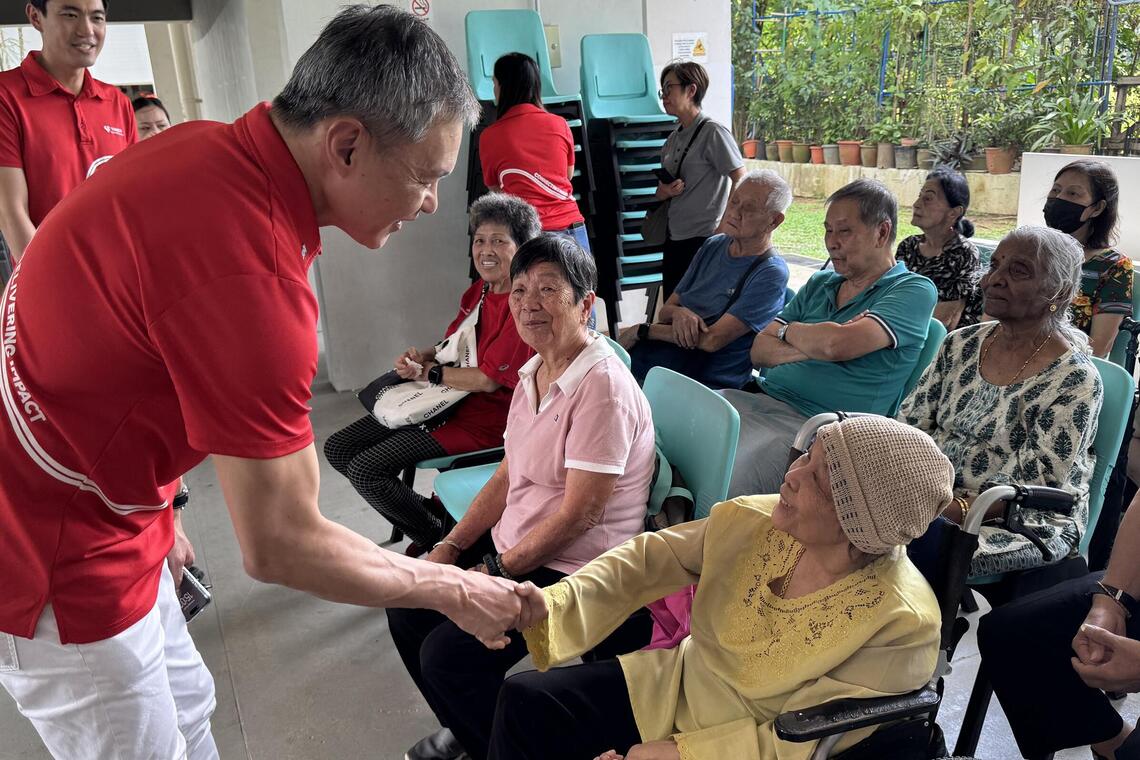
Seniors can help their peers by looking out for one another, taking fellow seniors down for a walk, helping them to buy meals, or taking them to active ageing centres.
“We want our beneficiaries not just to receive but to be able to give,” Mr Tan added.
TOUCH started another programme in 2022 to support seniors who are recovering from illness or surgery at home and in the community.
Mr Tan said the idea behind the 12-week programme is to help seniors get back on their feet and do things on their own. It would be a bonus if the senior decides to give back to the community, he added.
There is also a ready pool of the senior workforce that can be tapped to plug the manpower shortage.
Mr Tan said these seniors have retired, are fit and do not mind working for a few hours every day.
The key, he noted, is to redesign job roles and allow for more flexible working arrangements.
“Not everyone wants to work from 9am to 5pm. Some may want to look after grandchildren or want their own time,” he said.
They work because it gives them purpose and helps them feel that they still have value, Mr Tan added.
Financial experts say it is important to plan for a meaningful and purposeful retirement, failing which some retirees may find themselves having to cope with a sense of emptiness and loss of identity.
Ms Irma Hadikusuma, chief marketing and healthcare officer at AIA Singapore, said that “true retirement well-being encompasses far more than just financial security”.
She added that it is important that people plan for their physical, mental and social well-being post-retirement.
DBS’ Ms Tan said: “Many find fulfilment in discovering new things, volunteering, building memories with loved ones, and maintaining a regular exercise routine.
“Addressing these non-financial aspects ensures your retirement is not just financially secure, but also purposeful and enriching.”


 Posts
Posts


No comments:
Post a Comment