
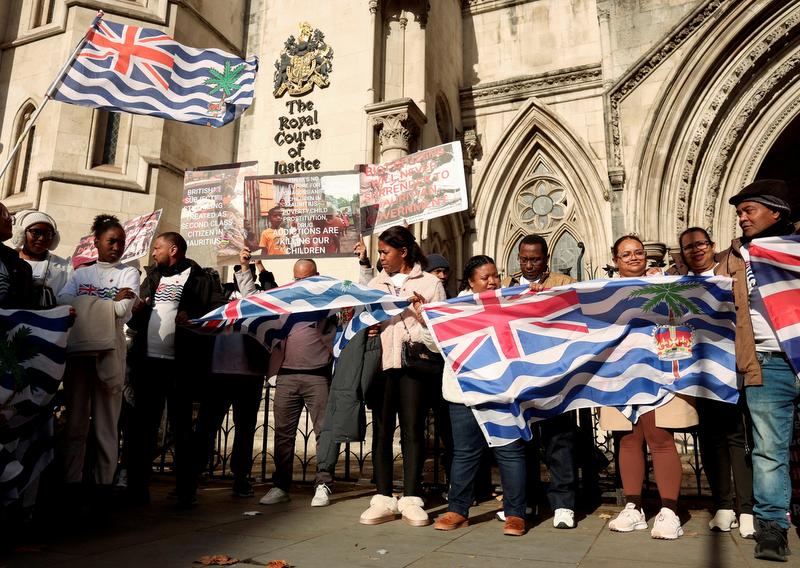
Protesters outside London’s High Court, where Chagossian campaigners are challenging the British government's deal to transfer sovereignty of the Chagos Islands to Mauritius, on Oct 28, 2025. The government has put the handover of sovereignty over the islands and a key military base on hold.PHOTO: REUTERS
China factor spices up tussle over key part of the Indian Ocean
US military airbase of Diego Garcia gets dragged into powerplay.
With the world’s eyes fixed on the war on Iran since February, and latterly, US President Donald Trump’s trip to meet his Chinese counterpart Xi Jinping in Beijing, it is no surprise that significant recent developments in an area in the south-west Indian Ocean that is as important to the US as is Guam in the Pacific, have passed largely under the radar.
The latest was the omission from the King’s Speech delivered to the British Parliament on May 13 of any reference to the planned British handover to Mauritius of sovereignty over the strategic Diego Garcia military base and the surrounding islands in the Chagos archipelago. The speech typically lays out the government’s legislative agenda and the lack of mention of the Chagos issue is the clearest indication that the long-negotiated handover has been shelved.
This follows from Britain’s refusal in January – as Mr Trump and Israeli Prime Minister Benjamin Netanyahu planned the war on Iran – to allow strikes to be conducted from Diego Garcia, which the US operates under lease from Britain. It prompted Mr Trump to attack Britain’s plans to hand over sovereignty as a sellout.
A permanent US military airbase supporting air and naval activity, Diego Garcia acts as a key launchpad to project power into the Middle East, South-east Asia and East Africa.
New twists have emerged since Britain declined permission for the initial strikes. Mauritius announced in late February that it was “suspending” diplomatic relations with the Maldives, its neighbour to the north. This came after the Maldives, led by Mr Mohammed Muizzu – who came to office in 2023 as a China-leaning figure standing on an “India Out” plank – reversed the previous government’s position and asserted its historical claims to the ownership of Chagos Archipelago.
Was Mr Muizzu acting alone, or, as China sceptics tend to believe, also on behalf of Beijing – which has in recent years sought to expand its influence in the Indian Ocean and has built up an impressive navy that makes it possible?
At April’s Ninth Indian Ocean Conference held in Port Louis, capital of Mauritius, the Maldives was not invited. And Mr Muizzu slammed Mauritius’ behaviour as “nonsensical, very immature and naive”.
In the middle of it all a small group of Chagossians led by a man named Louis Misley Mandarin – you read that right – landed on a Chagos island in mid-February, saying they intended to settle on the land their forefathers had been evicted from.
Turns out that Mr Mandarin, who refers to himself as First Minister in the Chagossian Government-in-Exile, is a former British army cook and bus-driving instructor who is backed by Mr Nigel Farage’s Reform UK, which opposes the Chagos handover to Mauritius.
About-turn on handover
Now, the long negotiated handover – blessed by Washington until Mr Trump reversed positions in January – is itself in question.
As the omission in the King’s Speech indicates, the British government, which shifted positions on Iran in April to allow the US to conduct “defensive operations” from Diego Garcia, has put the handover in a freeze.
As they say in Singapore’s coffee shops, how like dat?
To figure out that puzzle one needs to absorb some background. When Mauritius gained independence from Britain in 1968, the Chagos islands were detached and were afterwards known as British Indian Ocean Territory (BIOT). Two years earlier, Britain had leased Diego Garcia island to the US and the island has since been a key military outpost for US forces in the Indian Ocean, housing B-52 bombers and refuelling facilities, among other assets.
In the overall scheme of American global power projection, Diego Garcia in the Indian Ocean would be as important as Guam in the Pacific. For the Anglo-American alliance, it replaced RAF Gan, a secret air and naval facility that the British operated during World War II from Addu atoll in the southern Maldives.
Mauritius has consistently fought to get the Chagos islands back.
In 2015, its attempt to use the United Nations Convention on the Law of the Sea in response to Britain declaring a Marine Protected Area around the archipelago did not succeed. But four years later, a referral to the UN General Assembly (UNGA), which asked the International Court of Justice (ICJ) for an advisory opinion, gained more traction.
The UNGA framed the issue in a decolonisation context.
A direct implication of the ICJ ruling that followed in 2019 was that Mauritius could exercise sovereign control over the archipelago. Although Britain resisted the advisory opinion – and pointed out that it was non-binding – UNGA subsequently adopted a resolution welcoming the ICJ ruling. The vote was carried with 116 voting for the resolution, six against (including the US, Australia and Israel), and 56 abstentions.
It is at this point that the Biden administration seems to have weighed in with the suggestion that it was increasingly untenable for Britain to hold on to Chagos, and suggested it was time to look for innovative solutions.
The China factor
India, which has outsized influence in Mauritius mainly because seven in 10 of its people are of Indian ethnicity and predominantly Hindu, was also consulted. New Delhi appears to have endorsed Washington’s position. In internal discussions it also backed the US view that handing Chagos back to Mauritius would help add pressure on China regarding its maritime claims in East Asian waters.
Thus pressured, in 2022, Britain entered into negotiations with Mauritius, with the precondition that the Diego Garcia base would be retained by the US for the next 99 years. The Rishi Sunak government had all but wrapped up negotiations when fresh elections were called, and the government changed. The new government has merely completed formalities.
The deal on Diego Garcia guarantees Western security interests in the archipelago are undisturbed for a century. In May 2023, US Deputy Secretary of State Richard Verma visited Port Louis – the highest-ranking American diplomat to visit the country in 20 years – for an on-ground review, alongside officiating at a ground-breaking for a new US$301 million (S$383 million) US embassy building there.
Thus, the deal on Chagos is a four-way arrangement between Mauritius, Britain, US and India. The latter has increasingly turned into a net security provider in the western Indian Ocean, even as it rows a far slower oar in East Asia, where it is reluctant to be seen participating in security instruments that confront China directly.
Maldives inserting itself into the picture is the new complication. But in this, too, there are multiple nuances.
Ordinarily, President Muizzu’s claims on Chagos should have prompted diplomatic worry lines in New Delhi and Washington. It would have raised speculation that against a backdrop of waning American influence and the dip in bilateral ties between the Trump White House and India, he was again stepping up to do Beijing’s bidding in a vital corner of the globe.
Aside from the American base in Diego Garcia, China also keeps a watchful eye on Mauritius, particularly its deepening defence ties with India, exemplified in a new airstrip and jetty that the two nations jointly inaugurated on Agalega Island.
The facility operates front-line Indian maritime reconnaissance aircraft, including the P-81. Agalega joins the French Reunion Island to the south-west that consolidates the dominance of US-friendly forces in that part of the Indian Ocean.
While there is curiosity over Mr Muizzu’s positions, neither New Delhi nor Washington appear to be ready to call him out. Quiet diplomacy seems to be the approach India is taking. It could also be that both are preoccupied with their individual issues – the war going badly for Mr Trump and for Mr Modi, worries over the economy brought about by the fuel crisis.
Also, compulsions of geography and New Delhi’s diplomatic overtures have led Mr Muizzu to take a more centrist foreign policy line. India’s willingness to take sides is therefore on account of wanting to keep both Mauritius and Maldives in its corner.
Besides, a key reason it had backed a swift sovereignty handover is now moot. India was hoping that the British announcement, which came in October 2024, would bolster the electoral prospects of then PM Pravind Jugnauth, a close ally. However, the election held the following month saw Mr Jugnauth ejected by a landslide.
What now? The six-decades-long Chagossian wait to reoccupy their land seems likely to be extended a while longer. Mauritius will also need to wait to regain sovereignty over the island.
The already agreed long lease of Diego Garcia to the US is undisturbed in any circumstance, which effectively means little changes on the ground. Needless to say, the geopolitical fun and games will likely continue.


 Posts
Posts


No comments:
Post a Comment