
My Weight Statistics (2026-02-28) Monthly Weight Measurement on the 28th of Each Month Since 28 May 2007
Saturday, February 28, 2026

My 18-year Weight Management Records from 2007-05-28 to 2026-02-28 (by Calorie Restriction, i.e. Dietary Energy Restriction):

My 18-year Weight Management Records from 2007-05-28 to 2026-02-28 (by Calorie Restriction, i.e. Dietary Energy Restriction):
Note: According to the Singapore Health Promotion Board, a Healthy BMI is greater than18.5 and less than 23.0. A BMI less than 18.5 would mean that the individual is at risk of nutrition deficiency diseases and osteoporosis.
A BMI equal or greater than 23.0 would mean that the individual is at risk of obesity-related diseases. (Ref: DD-Md2022J28)
As of 2026-02-28,
Note: ### indicates BMI = 23 or > 23
Total number of Monthly Weight monitored was 225 (100%)
The no. of times my healthy BMI between 18.5 and 22.9 was 220 (97.777%)
The no. of times my unhealthy BMI equal or more than 23.000 was 5 (2.223%)
=======================
2007
2007-05-28 morning, my weight = 65.0 kg, BMI = 23.588###
2007-06-28 morning, my weight = 61.0 kg, BMI = 22.136
2007-07-28 morning, my weight = 59.0 kg, BMI = 21.410
2007-08-28 morning, my weight = 58.7 kg, BMI = 21.302
2007-09-28 morning, my weight = 57.5 kg, BMI = 20.866
2007-10-28 morning, my weight = 57.5 kg, BMI = 20.866
2007-11-28 morning, my weight = 56.2 kg, BMI = 20.394
2007-12-28 morning, my weight = 55.5 kg, BMI = 20.140
2008
2008-01-28 morning, my weight = 54.8 kg, BMI = 19.886
2008-02-28 morning, my weight = 54.8 kg, BMI = 19.886
2008-03-28 morning, my weight = 54.5 kg, BMI = 19.777
2008-04-28 morning, my weight = 54.4 kg, BMI = 19.741
2008-05-28 morning, my weight = 54.1 kg, BMI = 19.632
2008-06-28 morning, my weight = 54.6 kg, BMI = 19.814
2008-07-28 morning, my weight = 54.5 kg, BMI = 19.777
2008-08-28 morning, my weight = 54.3 kg, BMI = 19.705
2008-09-28 morning, my weight = 54.9 kg, BMI = 19.923
2008-10-28 morning, my weight = 55.3 kg, BMI = 20.068
2008-11-28 morning, my weight = 54.5 kg, BMI = 19.777
2008-12-28 morning, my weight = 55.6 kg, BMI = 20.177
2009
2009-01-28 morning, my weight = 54.8 kg, BMI = 19.886
2009-02-28 morning, my weight = 55.9 kg, BMI = 20.285
2009-03-28 morning, my weight = 54.8 kg, BMI = 19.886
2009-04-28 morning, my weight = 55.3 kg, BMI = 20.068
2009-05-28 morning, my weight = 55.4 kg, BMI = 20.104.
2009-06-28 morning, my weight = 55.2 kg, BMI = 20.031
2009-07-28 morning, my weight = 55.1 kg, BMI = 19.995
2009-08-28 morning, my weight = 55.2 kg, BMI = 20.031
2009-09-28 morning, my weight = 56.3 kg, BMI = 20.431
2009-10-28 morning, my weight = 55.8 kg, BMI = 20.249
2009-11-28 morning, my weight = 56.2 kg, BMI = 20.394
2009-12-28 morning, my weight = 56.1 kg, BMI = 20.358
2010
2010-01-28 morning, my weight = 55.6 kg, BMI = 20.177
2010-02-28 morning, my weight = 56.5 kg, BMI = 20.503
2010-03-28 morning, my weight = 56.4 kg, BMI = 20.467
2010-04-28 morning, my weight = 55.7 kg, BMI = 20.213
2010-05-28 morning, my weight = 55.1 kg, BMI = 19.995
2010-06-28 morning, my weight = 56.4 kg, BMI = 20.467
2010-07-28 morning, my weight = 55.5 kg, BMI = 20.140
2010-08-28 morning, my weight = 55.8 kg, BMI = 20.249
2010-09-28 morning, my weight = 55.8 kg, BMI = 20.249
2010-10-28 morning, my weight = 55.4 kg, BMI = 20.104
2010-11-28 morning, my weight = 55.6 kg, BMI = 20.177
2010-12-28 morning, my weight = 55.5 kg, BMI = 20.140
2011
2011-01-28 morning, my weight = 55.4 kg, BMI = 20.104
2011-02-28 morning, my weight = 56.5 kg, BMI = 20.503
2011-03-28 morning, my weight = 55.6 kg, BMI = 20.177
2011-04-28 morning, my weight = 55.7 kg, BMI = 20.213
2011-05-28 morning, my weight = 55.6 kg, BMI = 20.177
2011-06-28 morning, my weight = 56.3 kg, BMI = 20.431
2011-07-28 morning, my weight = 56.5 kg, BMI = 20.503
2011-08-28 morning, my weight = 56.9 kg, BMI = 20.649
2011-09-28 morning, my weight = 56.2 kg, BMI = 20.394
2011-10-28 morning, my weight = 56.8 kg, BMI = 20.613
2011-11-28 morning, my weight = 59.0 kg, BMI = 21.410
2011-12-28 morning, my weight = 60.3 kg, BMI = 21.882
2012
2012-01-28 morning, my weight = 61.5 kg, BMI = 22.318
2012-02-28 morning, my weight = 62.7 kg, BMI = 22.753
2012-03-28 morning, my weight = 62.5 kg, BMI = 22.681
2012-04-28 morning, my weight = 61.3 kg, BMI = 22.246
2012-05-28 morning, my weight = 60.7 kg, BMI = 22.028
2012-06-28 morning, my weight = 60.6 kg, BMI = 21.992
2012-07-28 morning, my weight = 61.2 kg, BMI = 22.209
2012-08-28 morning, my weight = 60.8 kg, BMI = 22.064
2012-09-28 morning, my weight = 61.5 kg, BMI = 22.318**
2012-10-28 morning, my weight = 62.3 kg, BMI = 22.608
2012-11-28 morning, my weight = 63.4 kg, BMI = 23.008###
2012-12-28 morning, my weight = 62.9 kg, BMI = 22.826
2013
2013-01-28 morning, my weight = 63.0 kg, BMI = 22.863
2013-02-28 morning, my weight = 62.1 kg, BMI = 22.536
2013-03-28 morning, my weight = 61.5 kg, BMI = 22.318
2013-04-28 morning, my weight = 63.1 kg, BMI = 22.899****
2013-05-28 morning, my weight = 62.3 kg, BMI = 22.608
2013-06-28 morning, my weight = 62.2 kg, BMI = 22.572
2013-07-28 morning, my weight = 62.4 kg, BMI = 22.645
2013-08-28 morning, my weight = 62.6 kg BMI = 22.717
2013-09-28 morning, my weight = 62.4 kg BMI = 22.645**
2013-10-28 morning, my weight = 62.3 kg BMI = 22.609
2013-11-28 morning, my weight = 63.1 kg BMI = 22.899
2013-12-28 morning, my weight = 64.4 kg BMI = 23.371###
2014
2014-01-28 morning, my weight = 63.6 kg, BMI = 23.080###
2014-02-28 morning, my weight = 63.3 kg, BMI = 22.971
2014-03-28 morning, my weight = 62.7 kg, BMI = 22.753
2014-04-28 morning, my weight = 62.7 kg, BMI = 22.753
2014-05-28 morning, my weight = 62.9 kg, BMI = 22.826
2014-06-28 morning, my weight = 63.1 kg BMI = 22.899
2014-07-28 morning, my weight = 62.7 kg, BMI = 22.753
2014-08-28 morning, my weight = 62.2 kg, BMI = 22.572
2014-09-28 morning, my weight = 61.2 kg, BMI = 22.209
2014-10-28 morning, my weight = 61.4 kg, BMI = 22.282
2014-11-28 morning, my weight = 60.2 kg, BMI = 21.846
2014-12-28 morning, my weight = 60.8 kg, BMI = 22.064
2015
2015-01-28 morning, my weight = 61.3 kg, BMI = 22.246
2015-02-28 morning, my weight = 61.8 kg, BMI = 22.427
2015-03-28 morning, my weight = 61.8 kg, BMI = 22.427
2015-04-28 morning, my weight = 62,5. kg, BMI = 22.681
2015-05-28 morning, my weight = 62.4 kg, BMI = 22.645
2015-06-28 morning, my weight = 63.6 kg, BMI = 23.080###
2015-07-28 morning, my weight = 62.3 kg BMI = 22.609
2015-08-28 morning, my weight = 62.2 kg, BMI = 22.572
2015-09-28 morning, my weight = 63.0 kg, BMI = 22.863
2015-10-28 morning, my weight = 63.2 kg, BMI = 22.935
2015-11-28 morning, my weight = 62.6 kg, BMI = 22.717
2015-12-28 morning, my weight = 62.3 kg BMI = 22.609
2016
2016-01-28 morning, my weight = 63.0 kg, BMI = 22.863
2016-02-28 morning, my weight = 62.8 kg, BMI = 22.790
2016-03-28 morning, my weight = 62.0 kg, BMI = 22.499
2016-04-28 morning, my weight = 62.0 kg, BMI = 22.499
2016-05-28 morning, my weight = 62.4 kg, BMI = 22.645
2016-06-28 morning, my weight = 62.1 kg, BMI = 22.536
2016-07-28 morning, my weight = 62.2 kg, BMI = 22.572
2016-08-28 morning, my weight = 62.6 kg, BMI = 22.717
2016-09-28 morning, my weight = 62.8 kg, BMI = 22.790
2016-10-28 morning, my weight = 62,5. kg, BMI = 22.681
2016-11-28 morning, my weight = 62.1 kg, BMI = 22.536
2016-12-28 morning, my weight = 62.3 kg, BMI = 22.608
2017
2017-01-28 morning, my weight = 62.9 kg, BMI = 22.826
2017-02-28 morning, my weight = 62.4 kg, BMI = 22.644
2017-03-28 morning, my weight = 62.8 kg, BMI = 22.789
2017-04-28 morning, my weight = 62.3 kg, BMI = 22.609
2017-05-28 morning, my weight = 62.2 kg, BMI = 22.572
2017-06-28 morning, my weight = 62.6 kg, BMI = 22.717
2017-07-28 morning, my weight = 62.4 kg, BMI = 22.645
2017-08-28 morning, my weight = 61.9 kg, BMI = 22.463
2017-09-28 morning, my weight = 62.0 kg, BMI = 22.499
2017-10-28 morning, my weight = 62.0 kg, BMI = 22.499
2017-11-28 morning, my weight = 61.5 kg, BMI = 22.318
2017-12-28 morning, my weight = 61.5 kg, BMI = 22.318
2018
My Weight 2018-01-28 0934 hr 61.0 kg BMI 22.136
My Weight 2018-02-28 0915 hr 60.7 kg BMI 22.027
My Weight 2018-03-28 0620 hr 61.0 kg BMI 22.136
My Weight 2018-04-28 1005 hr 61.7 kg BMI 22.390
My Weight 2018-05-28 0856 hr 60.5 kg BMI 21.955
My Weight 2018-06-28 0600 hr 61.4 kg BMI 22.281
My Weight 2018-07-28 0600 hr 62.2 kg BMI 22.572
My Weight 2018-08-28 0720 hr 61.4 kg BMI 22.281
My Weight 2018-09-28 0805 hr 62.1 kg BMI 22.535
My Weight 2018-10-28 0750 hr 61.3 kg BMI 22.24
My Weight 2018-11-28 1000 hr 61.5 kg BMI 22.318
My Weight 2018-12-28 0650 hr 62.5 kg BMI 22.681
2019
2019-01-28 at 1000 hr 60.9 kg BMI 22.100
2019-02-28 at 0946 hr 61.0 kg BMI 22.136
2019-03-28 at 0700 hr 62.4 kg BMI 22.644
2019-04-28 at 0828 hr 62.9 kg BMI 22.826
2019-05-28 at 0745 hr 62.4 kg BMI 22.826
2019-06-28 at 0650 hr 62.4 kg BMI 22.644
2019-07-28 at 0736 hr 62.8 kg BMI 22.789
2019-08-28 at 0629 hr 62.4 kg BMI 22.644
2019-09-28 at 0644 hr 61.9 kg BMI 22.463
2019-10-28 at 0740 hr 62.5 kg BMI 22.681
2019-11-28 at 0632 hr 62.8 kg BMI 22.789
2019-12-28 at 0726 hr 62.5 kg BMI 22.681
2020
My Weight 2020-01-28 0625 HR 62.6 kg BMI 22.717
My Weight 2020-02-28 0728 HR 62.3 kg BMI 22.608
My Weight 2020-03-28 0649 HR 61.4 kg BMI 22.281
My Weight 2020-04-28 0810 HR 62.0 kg BMI 22.499
My Weight 2020-05-28 0714 HR 62.3 kg BMI 22.608
My Weight 2020-06-28 0757 HR 60.2 kg BMI 21.846
My Weight 2020-07-28 0715 HR 61.6 kg BMI 22.354
My Weight 2020-08-28 0707 HR 61.1 kg BMI 22.173
My Weight 2020-09-28 0609 HR 60.8 kg BMI 22.064
My Weight 2020-10-28 0818 HR 60.7 kg BMI 22.027
My Weight 2020-11-28 0706 HR 60.9 kg BMI 22.100
My Weight 2020-12-28 0631 HR 60.5 kg BMI 21.955
2021
My Weight 2021-01-28 0638 HR 61.3 kg BMI 22.245
My Weight 2021-02-28 0741 HR 61.2 kg BMI 22.209
My Weight 2021-03-28 0659 HR 61.3 kg BMI 22.245
My Weight 2021-04-28 0659 HR 61.1 kg BMI 22.173
My Weight 2021-05-28 0618 HR 61.1 kg BMI 22.173
My Weight 2021-06-28 0604 HR 61.3 kg BMI 22.245
My Weight 2021-07-28 0642 HR 61.2 kg BMI 22.209
My Weight 2021-08-28 0653 HR 61.5 kg BMI 22.318
My Weight 2021-09-28 0618 HR 61.5 kg BMI 22.318
My Weight 2021-10-28 0549 HR 61.0 kg BMI 22.136
My Weight 2021-11-28 0630 HR 61.3 kg BMI 22.245
My Weight 2021-12-28 0528 HR 61.6 kg BMI 22.354
======================================
2022
My Weight 2022-01-28 0910 HR 61.1 kg BMI 22.173
My Weight 2022-02-28 0642 HR 61.2 kg BMI 22.209
My Weight 2022-03-28 0649 HR 61.4 kg BMI 22.281
My Weight 2022-04-28 0649 HR 61.4 kg BMI 22.281
My Weight 2022-05-28 0549 HR 61.0 kg BMI 22.136
My Weight 2022-06-28 0549 HR 61.0 kg BMI 22.136
My Weight 2022-07-28 0700 HR 60.6 kg BMI 21.991
My Weight 2022-08-28 0640 HR 61.3 kg BMI 22.245
My Weight 2022-09-28 0738 HR 61.7 kg BMI 22.390
My Weight 2022-10-28 0708 HR 61.5 kg BMI 22.318
My Weight 2022-11-28 0706 HR 60.9 kg BMI 22.100
My Weight 2022-12-28 0722 HR 61.1 kg BMI 22.173
========
2023
My Weight 2023-01-28 0537 HR 60.9 kg BMI 22.100
My Weight 2023-02-28 0515 HR 61.4 kg BMI 22.281
My Weight 2023-03-28 0606 HR 61.3 kg BMI 22.245
My Weight 2023-04-28 0738 HR 61.3 kg BMI 22.245
My Weight 2023-05-28 0721 HR 61.0 kg BMI 22.136
My Weight 2023-06-28 0641 HR 61.2 kg BMI 22.209
My Weight 2023-07-28 0700 HR 60.9 kg BMI 22.100
My Weight 2023-08-28 0655 HR 61.3 kg BMI 22.245
My Weight 2022-09-28 0738 HR 61.7 kg BMI 22.390
My Weight 2022-10-28 0708 HR 61.5 kg BMI 22.318
My Weight 2023-11-28 0612 HR 61.4 kg BMI 22.281
My Weight 2023-12-28 0734HR 61.3 kg BMI 22.245
========
2024
My Weight 2024-01-28 0734 HR 61.3 kg BMI 22.245
My Weight 2024-02-28 0510 HR 61.6 kg BMI 22.354
My Weight 2024-03-28 0642 HR 60.9 kg BMI 22.100
My Weight 2024-04-28 0721 HR 61.1 kg BMI 22.173
My Weight 2024-05-28 0537 HR 61.3 kg BMI 22.245
My Weight 2024-06-28 0651 HR 61.5 kg BMI 22.318
My Weight 2024-07-28 0612 HR 61.4 kg BMI 22.281
My Weight 2024-08-28 0747 HR 61.1 kg BMI 22.173
My Weight 2024-09-28 0640 HR 61.1 kg BMI 22.173
My Weight 2024-10-28 0546 HR 61.5 kg BMI 22.318
My Weight 2024-11-28 0706 HR 61.4 kg BMI 22.281
My Weight 2024-12-28 0649 HR 61.9 kg BMI 22.463
=======================================
2025
My Weight 2025-01-28 0625 HR 61.6 kg BMI 22.354
My Weight 2025-02-28 0742 HR 61.5 kg BMI 22.318
My Weight 2025-03-28 0640 HR 61.6 kg BMI 22.354
My Weight 2025-04-28 0734 HR 61.7 kg BMI 22.390
My Weight 2025-05-28 0738 HR 61.8 kg BMI 22.427
My Weight 2025-06-28 0606 HR 62.6 kg BMI 22.717
My Weight 2025-07-28 0757 HR 62.7 kg BMI 22.753
My Weight 2025-08-28 0546 HR 62.6 kg, BMI 22.717
My Weight 2025-09-28 0540 HR 62.2 kg BMI 22.572
My Weight 2025-10-28 0516 HR 62.4 kg BMI 22.644
My Weight 2025-11-28 0810 HR 62.1 kg BMI 22.535
My Weight 2025-12-28 0702 HR 62.2 kg BMI 22.572
=========================
2026
My Weight 2026-01-28 0733 HR 61.9 kg BMI 22.463
My Weight 2026-02-28 0649 HR 62.4 kg BMI 22.644
=========================
Note:
My current BMI is within the healthy range of 18.5 to 22.9.
For me, the range of healthy weight is 50.9786 kg (BMI = 18.5) to 63.10324 kg (BMI = 22.9).
People with BMI values of 23 kg/m2 (or 25 kg/m2 according to some sources) and above have been found to be at risk of developing heart disease and diabetes.
To be healthy, I must have a healthy weight.
Be as lean as possible without being underweight, as recommended by World Cancer Prevention Foundation, United Kingdom.
=================================
Note: On 2021-05-28, I removed the unimportant details of old records from My Weight Management Records.
=================================
Ref. WeightManagement
When "Very Chinese" Becomes a Trendy Gesture

For subscribers
Translated by Doubao (with minor editing)
https://www.zaobao.com.sg/forum/views/story20260228-8650298?utm_source=android-share&utm_medium=app
2026-02-28
By Huang Weiman
If young Singaporeans, while embracing Chinese brands and culture, can also express their Singaporean identity with greater confidence—such as using Mandarin more comfortably and telling stories of the local Chinese community—they may come to a clearer realization that being "Chinese" is not an extension of any country's capital or narrative, and in doing so, carve out a new narrative space for Chinese identity.
During this Chinese New Year, social media was filled with Chinese New Year-related content such as reunion dinners and what to wear during New Year Visiting on one hand, while more intense discussions emerged on the other—many ethnic Chinese internet celebrities and celebrities I follow have fiercely criticized an online phenomenon: the recently popular phrase "very Chinese".
Since the end of last year, a series of trendy expressions have appeared on the English internet. Among them, the most widely used one is "You met me at a very Chinese time in my life"; some also joke that they "woke up feeling suddenly very Chinese" or quip that they "just got diagnosed as Chinese".
These English captions are often paired with content related to Eastern culture or China, including Chinese-style makeup, fashion, health preservation, or travel information about China, to showcase the Eastern pace of life or create an atmosphere of being familiar with Chinese culture. Participants include both young ethnic Chinese and many non-Chinese people.
A short video of stand-up comedian Jimmy O. Yang wearing a Chinese-style jacket launched by Adidas, looking back and singing A Spray of Plum Blossoms on the grassland, is the most representative example of this trend. During the New Year, more netizens drew inspiration from this and created videos declaring themselves "very Chinese".
However, this online phenomenon has also stirred up feelings of discomfort and unease in the overseas Chinese community. Maggie Zhou, an Australian Chinese fashion and culture writer, pointed out in a recent podcast that this trend turns Chinese culture into a joke, reduces identity to a consumable life experience, and compresses it into wearable, Instagrammable elements. Yet for many overseas Chinese, the real-life experience interwoven with their names, accents, family expectations and social labels is not a phased choice, but a long-term cultural reality.
The internet allows identity to be performed, yet it may also overshadow the real people behind it.
Simu Liu, the Canadian Chinese actor who rose to fame for playing the lead superhero role in the Marvel film Shang-Chi and the Legend of the Ten Rings, has pushed back against this trend in a more positive way. Last Thursday, he posted a video on his social media platforms teaching people how to pronounce his name correctly when addressing him.
Half-jokingly, he said: If people claim to be in a "very Chinese" phase of their lives, they should at least pronounce his surname (Liu) correctly. Though his tone was light, it carried an unignorable reminder: when being "very Chinese" becomes a gesture, the most basic understanding and respect should follow suit.
The popularity of this identity expression of being "very Chinese" is interesting on many levels. It is both the commercialization of cultural symbols and a sign that Chinese culture can now be displayed proactively and confidently. Following the "K-wave" and "Japanese style", being "very Chinese" has also begun to become a label for global aesthetic tastes and lifestyles.
Especially as Chinese brands expand overseas and many foreigners choose to travel to China driven by the country's visa-free entry policy, the "very Chinese" lifestyle has become more widely accessible. Globalization is no longer a one-way street of Western output and Eastern absorption as it once was.
International media have also quickly attached a more grand significance to it. The South China Morning Post noted that these memes reflect that the technological platforms built by China have become deeply embedded in the global internet; Wired magazine in the US believes that it symbolizes the disillusionment of some young Americans with the current state of their country and is an emotional response to the global landscape.
As a Singaporean Chinese, I couldn't help but feel a subtle sense of dissonance when I came across the playful "very Chinese" tags during Chinese New Year. Chinese form the majority in Singapore, and the society is highly diverse and open, so this Western-originated meme does not cause resentment. But the complex feeling lies in the fact that China today is not just a cultural symbol, but a rising economic and technological power. Will this create a cumulative effect—when China becomes a symbol of a great power, will being "Chinese" also be more easily simply equated with and bound to China?
Against this backdrop, on the one hand, we hope that the younger generation will cherish their Chinese identity and cultural traditions more, and we are heartened to see them enthusiastically show their "very Chinese" side; on the other hand, if the identity of Singaporean Chinese is not built on a solid and diverse cultural and linguistic foundation, their display of being "very Chinese" will be more of an aesthetic choice of liking China, leading to a greater disconnect from the understanding of Chinese identity held by their ancestors shaped by memories of survival.
A feature article published by Lianhe Zaobao on February 20 mentioned that the usage rate of Xiaohongshu, a Chinese social media platform, is on the rise in Southeast Asia, with the region recording 25 million monthly active users last year, a trend that is particularly prominent in Singapore, opening a window for the local public to understand China. A global survey released by the renowned polling firm Pew Research Center last July also showed that global public favorability toward China has risen to a six-year high.
The popularity of "very Chinese" reminds us that identity is being rewritten. For Singaporean Chinese, this is both an opportunity and a test. We must pay attention to how the recognition of being "Chinese" will be guided by external narratives as China's weight in the global context grows.
But optimistically, this trend may also become an opportunity at the same time, prompting the younger generation to think more actively about their cultural position instead of avoiding or downplaying it. If young Singaporeans, while embracing Chinese brands and culture, can also express their Singaporean identity with greater confidence—such as using Mandarin more comfortably and telling stories of the local Chinese community—they may come to a clearer realization that being "Chinese" is not an extension of any country's capital or narrative, and in doing so, carve out a new narrative space for Chinese identity.
The author is a media professional.
收入最高前1000名新加坡公民 一半人年赚逾310万元

https://www.zaobao.com.sg/news/singapore/story20260227-8650057?utm_source=android-share&utm_medium=app
2026-02-27
在2024估税年,全新加坡收入最高的1000名公民中,有一半人年赚超过310万元,其中250人的年收入多过450万元。
交通部代部长兼财政部高级政务部长萧振祥星期五(2月27日)以书面答复工人党阿裕尼集选区议员莫哈默法理的询问时指出,在2024估税年,排名前1000的最高收入新加坡公民当中,第25百分位数赚250万元、中位数赚310万元、第75百分位数赚450万新元。
此外,萧振祥星期三(2月25日)在国会答复工人党阿裕尼集选区议员严燕松的提问时也披露,新加坡最富裕的1%家庭,拥有全国约14%的家庭总财富;若看最富有的5%,则合计掌握约33%的财富。
财政部2月发布《新加坡收入增长、不平等和社会流动趋势》报告,首次公布以家庭净财富计算的财富基尼系数(Wealth Gini coefficient),为0.55。
我国过去只公布收入基尼系数,去年的收入基尼系数为0.452;在计入政府转移和税收后,降至0.379。
延伸阅读
我国最富有1%家庭握14%财富 政府持续追踪财富分布变化
最富5%掌握三分之一家庭财富 新加坡贫富差距有多大?
萧振祥说,政府将持续追踪这一指标。随着下一轮“家庭开销调查”预计在2028年展开,政府也会研究是否提供更多相关指标,以加强监测我国财富分布的情况。
黄伟曼:当“很Chinese”成为潮流姿态

https://www.zaobao.com.sg/forum/views/story20260228-8650298?utm_source=android-share&utm_medium=app
2026-02-28
如果新加坡年轻人在拥抱中国品牌与文化的同时,也能更自信地表达自己的新加坡身份——例如更自在地使用华语、讲述本地华人社会的故事——或许就能更清楚地意识到,“华人”并非任何国家资本或叙事的延伸,也为华人身份找到新的叙事空间。
今年的农历新年,社交媒体上一边是团圆饭、拜年穿搭等与节庆相关的内容,另一边却浮现更尖锐的讨论——好些我追踪的华裔网红与明星都在热烈地批判一个网络现象:近来流行的“很Chinese”(很中国/很华人)这种说法。
自去年底起,英语互联网出现这一系列时髦的表达。其中,最广泛使用的有“你在我人生中非常Chinese的阶段认识了我”(You met me at a very Chinese time in my life);也有人戏称自己“早上醒来突然很Chinese”、调侃自己“刚被诊断为Chinese”等。
这些英语说明文字,往往配上与东方文化或中国有关的内容,包括中式妆容、穿搭、养生或中国旅游资讯,借此展示东方的生活节奏,或营造一种自己熟悉华人文化的氛围。参与者既有年轻华人,也有不少非华族人士。
脱口秀艺人欧阳万成(Jimmy O. Yang)穿着阿迪达斯(Adidas)推出的中式夹克,在草原上回眸唱《一剪梅》的短视频,便是其中最具代表性的例子。新年期间也有更多网民以此为灵感,同样创作宣示自己“很Chinese”的视频。
然而,这个网络现象也挑起海外华人社群不舒服与不安的情绪。澳大利亚华裔时尚与文化作家周美琪(Maggie Zhou)在最近一集播客指出,这股风潮把华人文化变成笑点,将身份当成可消费的生活经验,压缩成可穿戴、可打卡的元素。然而,对许多海外华人而言,姓名、口音、家庭期待与社会标签交织而成的现实经验,并非阶段性选择,而是长期的文化处境。
网络让身份得以被表演,却也可能遮蔽真实生活中的人。
因在漫威电影《尚气与十环帮传奇》饰演超级英雄主角而爆红的加拿大华裔演员刘思幕(Simu Liu)则以较积极的方式抵抗这个潮流。上周四,他在自己的社媒平台上发布视频,教导大家如何在称呼他时确保名字发音正确。
他半开玩笑地说:如果人们宣称自己正处在人生“很Chinese”的阶段,那他们至少要把自己的姓氏(即“刘”这个字)念对。他虽语气轻松,却带着不容忽视的提醒:当“很中国”成为姿态时,最基本的理解与尊重也应跟上。
“很中国”或“很华人”的这种身份表达火起来,从许多层面上看都挺有意思。它既是文化符号的商品化,也显示中国文化已能被主动、自信地展示。继“韩流”“日系”之后,“很中国”也开始成为全球审美与生活方式的一种标签。
尤其当中国品牌纷纷出海,并在中国免签入境政策推动下,不少外国人选择到中国旅游时,“很中国”的生活方式也变得容易流通。全球化不再像以前一样,只是西方输出,东方吸收。
国际媒体也迅速赋予它更宏大的意义。《南华早报》指出,这些迷因(meme)反映中国构建的技术平台已深嵌全球互联网;美国《Wired》则认为,它象征部分美国年轻人对本国现状的失落,是对世界格局的情绪回应。
身为新加坡华人,我在农历新年刷到“很Chinese”的玩笑标签时,心里则不免生出微妙的错位感。新加坡华人占多数,社会高度多元和开放,因此这种源自西方的迷因不让人反感。但心情复杂之处在于,当下的“中国”已不只是文化意象,而是正在崛起的经济与科技强国。这是否会产生叠加效应,当“中国”成为强国意象时,“华人”是否也更容易被简单等同于中国,与此绑定?
在这样的背景下,我们一方面希望年轻一代更珍视自身的华族身份与文化传统,若看到他们热情展示自己“很Chinese”的一面时也甚是欣慰;另一方面,新加坡华人的身份认同若没有建立在扎实而多元的文化和语言基础上,其“很Chinese”的表现更多是一种喜欢中国的审美选择,与祖辈华人因生存记忆而对华族身份出现的理解将会有更大落差。
《联合早报》2月20日发布的一篇特稿提到,中国社媒平台小红书在东南亚的使用率呈上升趋势,该区域去年每月活跃用户已达2500万,在新加坡尤为显著,也为本地公众打开一扇认识中国的窗口。去年7月知名民调机构皮尤发布一份全球调查也显示,全球民众对中国的好感度升至六年来新高。
“很Chinese”的流行提醒我们,身份正在被重新书写。对新加坡华人而言,这既是机遇,也是考验。我们必须留意的是,当“中国”在全球语境中的分量上升,“华人”的认同将如何被外部叙事所牵引。
但乐观地看,这股趋势与此同时也可能成为一次契机,促使年轻一代更主动思考自己的文化位置,而不是回避或淡化它。如果新加坡年轻人在拥抱中国品牌与文化的同时,也能更自信地表达自己的新加坡身份——例如更自在地使用华语、讲述本地华人社会的故事——或许就能更清楚地意识到,“华人”并非任何国家资本或叙事的延伸,也为华人身份找到新的叙事空间。
作者是媒体工作者
The way we define success makes it hard to raise children in Singapore

The way we define success makes it hard to raise children in Singapore
https://www.straitstimes.com/opinion/the-way-we-define-success-makes-it-hard-to-raise-children-in-singapore
2026-02-28
By--- Vincent Chua is associate professor in the Department of Sociology and Anthropology at the National University of Singapore.
Tan Poh Lin is senior research fellow at the Institute of Policy Studies, National University of Singapore.
=====
Singapore’s fertility problem is often framed as a question of costs, time and support.
Housing prices, childcare availability and parental leave all matter. But they do not fully explain why many couples, including those who are financially stable, delay having children or stop at one.
Beneath these practical concerns lies a deeper issue: the way society defines success.
Raising a child in Singapore has become both expensive and stressful. Parenting is increasingly experienced as a high-stakes project with timelines, milestones and strong expectations. Within this frame, children are not seen simply as persons to be nurtured, but “projects” to be optimised. Parents themselves feel constantly evaluated.
On Feb 26, Deputy Prime Minister Gan Kim Yong announced during the Budget debate that Singapore’s total fertility rate (TFR) has sunk to a new low of 0.87, sparking fears of an irreversible decline in births.
While there have been calls by the Government to ease the pressure, parents are merely responding to a competitive environment that encourages them to pour ever more time, money and attention into each child. This competition has a predictable effect: families have fewer children and/or invest more in each one.
A low TFR is not a failure of individual priorities, but rather a structural outcome of how success is organised, measured and rewarded.
What needs to change
The Government recognises the issue and has pledged to tackle the education “arms race”, including measures such as reviewing exam difficulty and how PSLE scores are used. These are welcome steps. But they do not fully address the root of the issue.
Parents routinely say they want happier, less stressful childhoods for their children and that they value multiple pathways to a fulfilling life. Yet many families remain invested in chasing after narrow measures of academic success.
The contradiction persists because while parents see the value of less academic pressure, opting out individually still feels risky in a system where success is equated with visible achievement within a tight and well-defined hierarchy.
As long as this remains, softening one metric risks a familiar paradox. The implicit message becomes that grades still matter, but are no longer enough. Students will feel compelled to compete harder for leadership awards and sports medals, just to stand out. The academic race simply spills across more lanes.
What needs to change, therefore, is not only how we assess children but how we understand success itself.
Cultural shifts do not happen simply because someone makes a compelling argument. They happen when the old ways of seeing stop explaining what people repeatedly experience. When belief and reality diverge often enough, people are forced to revise how they see the world.
We have seen this process at work before.
Long-standing beliefs about who could do certain kinds of work, particularly along gender lines, did not change just because societies suddenly became more enlightened.
They changed because reality kept contradicting the script. Women’s sustained presence and success in roles once deemed unsuitable – from skilled manufacturing to professional and technical work – gradually made old assumptions untenable, forcing a rewriting of the gender script.
A key insight is that the definition of success is itself a social construct we have invented.
More On This Topic
The case for acknowledging joy in our conversations about family
Will an endowment of $300,000 per child move the needle?
Catalysts for a cultural shift
In modern society, success is often measured by what we own. In Singapore, this is commonly summed up as the “5Cs”. But this reflects only what society chooses to value, not what truly matters in a life.
On this front, Gen Zs are already charting lives that extend beyond the 5Cs towards broader measures of quality of life.
Material conditions still matter to be sure. But they are no longer seen as sufficient. The aspiration is not to reject success, but to define it more fully to encompass well-being.
There is no reason success should be confined to material gain. Why should kindness, solidarity, contentment or mastery of a skill – even one dismissed as “low-skilled” – or being at peace with oneself, count for less than visible achievement?
Acting with consideration for others, for instance, is rarely treated as a marker of success, while visible achievement is celebrated, even if it came at a cost to someone else.
We suggest three kinds of experiences that can bring about a cultural shift.
First, when someone you respect thrives despite not having “won” the race early on.
Many of us might know someone who was never top of the class or part of an elite group, but who grew into a competent, respected and fulfilled adult.
These stories of late bloomers should be shared widely and celebrated. Normalising such narratives helps us see ability not as a fixed trait revealed in childhood, but as something that evolves over time, in different ways, at different speeds.
Recent changes in the gifted education programme reflect this shift. Moving away from a one-off selection process towards school-based enrichment, with opportunities for entry at multiple points, acknowledges that potential can emerge later and should not be locked in early.
By renewing access rather than granting it permanently, the system places greater emphasis on growth than on precocity.
As similar patterns take hold across schools, workplaces and institutions, the assumed link between early academic success and future success is gradually challenged.
When people repeatedly encounter capable, respected adults who did not excel early, the old story weakens and eventually loses its hold.
Second, when you notice more high achievers choosing paths that do not maximise status.
A powerful and persuasive mismatch occurs when people see individuals with stellar academic records choosing directions not conventionally associated with prestige.
Think of people pursuing excellence in a trade, a craft or a skill, such as urban farming, genealogy or photography, which may not be in line with traditional educational achievements, but which require hours of practice and fine-tuning.
This means that students need exposure to a wide variety of co-curricular activities, and access to recreational tiers with no need to pass a selection trial.
Specialisation at earlier ages should be de-emphasised in favour of more opportunities to roam and explore, to learn something for its own sake, rather than to get a leg-up on the academic race.
More On This Topic
S’pore needs to reset views on marriage, parenthood; new work group to study issues: Indranee
When did conversations on parenthood and fertility in S’pore become such a downer?
Independence, flexibility and adaptability are needed more than ever, especially in an era of industrial turbulence, where business models are ever-evolving and sticking to traditional forms of learning no longer guarantees career success.
Multiplicity of pathways softens the assumption that the purpose of academic success is always to ascend the same one hierarchy. They show that achievement can lead to many kinds of meaningful lives.
For all that to work, we need the third – and most powerful experience – seeing and treating people with dignity regardless of class or status.
Schools already have a powerful tool in Character and Citizenship Education, which helps the next generation acquire the ethical reasoning skills they need to introspect and grapple with the meaning and purpose of achievement, and to develop concepts of success that are more community-oriented than self-oriented.
What is needed is more curriculum emphasis and adequate time to teach these concepts and values, and to count them as equally esteemed measures of success.
These skills allow students to put their studies in perspective, not just as a mechanical means to success, but as an opportunity to gain abilities beyond the classroom that will ready them for navigating human relationships and life itself.
Here, not just schools but all of society has a role to play. When workplaces, institutions and communities treat individuals with respect, regardless of credentials, something shifts internally.
Change the environment, and minds gradually follow in order to stay consistent with lived experience. It gradually changes what the eye sees, until the brain updates how it interprets the world.
Such profound and broad-based changes are difficult to push and will be slow. But they are necessary if Singapore is to be a place where people can raise children with confidence and care.
This requires letting go of a single, unforgiving measure of success, and broadening our understanding of what counts as a good life.
Vincent Chua is associate professor in the Department of Sociology and Anthropology at the National University of Singapore.
Tan Poh Lin is senior research fellow at the Institute of Policy Studies, National University of Singapore.

Friday, February 27, 2026
黄信谊:相信。

黄信谊:相信
https://www.zaobao.com.sg/lifestyle/gen/story20260226-8637504?utm_source=android-share&utm_medium=app
2026-02-26
======


2026米兰冬奥会的帷幕落下了。电视台并未转播,但我们一家还是摸着黑灯瞎火追踪赛事的去向,比赛很刺激,困意也来得很肆意,但即便如此我们仍坚守着直播,重在一种“参与感”。我对奥运的记忆从2008年北京开始,那个年纪的我对体育赛事一无所知,奥运对于我来说只是华丽的开幕式和电视里的热闹。
真正关注到赛事是东京奥运,当时我们仍被疫情的阴影笼罩,日本顶着各种压力举办了这场因疫情已延期一年的夏季奥运会。除比赛期间,运动员们戴着口罩,本应充满欢呼声的观赛席空空荡荡。虽同以往每届不同,甚至有些令人担忧的冷清,但作为疫情后的第一场大型国际赛事,它引导着世界重新步入正轨,也为屏幕另一端的观众带来了重新展望未来的信心。停摆了近三年的齿轮缓缓地转动了起来。
“For every girl with a dream”
19岁的德国自由式滑雪运动员穆里尔·莫尔(Muriel Mohr)在米兰冬奥会女子双板大跳台预赛完成第三跳后,拿起手机,用明亮的粉色写下了这句话,并举向镜头。这一幕让身在电视机前同为女性的我觉得她正在发光,那股力量虽不张扬,却温柔地击穿了所有。而我肯定不是屏幕前唯一怀揣着梦想的女孩,相信有千千万万处在不同阶段的女性,都能从莫尔传递的那份力量里看见自己,再延续给他人。
另一位受到众人关注的选手是22岁的自由式滑雪运动员谷爱凌,她以1金2银的成绩完美收官。2022年的北京冬奥会上,谷爱凌闯入大众的视野,揽下了大跳台和U型场地技巧的金牌,坡面障碍技巧的银牌。当时的她18岁,胜利后迅速涌来的是漫天的掌声与鲜花,人们谈论她的天赋、选择乃至出身,可竞技体育的高光时刻不是永久的。2025年受伤后,她不再频繁出现在赛场上,转而给了想象与舆论的空间,而这空间瞬时便被猜测,质疑和不友善的揣测填满。
在谷爱凌纪录片《再出发》中,可以看到一个刚满20岁的女孩,她的迷茫和不断与之斗争的精神。看似乐观、大大咧咧的她,其实每日都会深度自省,需要大量个人时间去消化压力,情绪与思绪。记忆比较深刻的是,她会给自己“哭的时间”,因为发泄情绪是很耗体力和脑力的。看着她在跑步机上边跑边哭的画面,让人觉得她很可爱,但也非常厉害,她能够掌控自己的情绪,不让它反过来控制身体的节奏。而我,一个照理说前额叶已成熟的人,却常常做不到这一点。
“You can control how you think, and therefore you can control who you are.”
相信“相信”的力量,这是我从她身上最直观学到的,也是在每一位运动员身上看到的。有些梦想或许在成为一个按部就班的大人后会悄然沉寂,可却从来没有消失。奥运这样的时刻,让我在每一次运动员们的起跳、奔跑和冲刺中,找回自己的心跳,但生活不可能天天是奥运,不会每天都有外界的刺激,终究还是会趋于平静,而能提醒自己的,往往就是脑子里的那声音。
所以,如果哪天情绪失控,计划落空,人生像跳台失误一样偏离轨道,那我也想学会告诉自己没关系,大不了就哭5分钟嘛,哭完继续。毕竟,能控制自己怎么想,已经很厉害了。至于最终想成为谁,我想慢一点,应该也没关系。
联合早报社论 (2026-02-27):重塑生育理念

https://www.zaobao.com.sg/forum/editorial/story20260227-8645663?utm_source=android-share&utm_medium=app
2026-02-27
星期五
=====
新加坡的生育率正滑向越来越令人不安的区间。2024年作为原本被寄予厚望的龙年,并未带来明显的“催生效应”,2025年蛇年的出生人数进一步下降虽在意料中,但最新公布的数据仍令人震惊:整体生育率(TFR)从2024年的0.97跌至0.87,再创历史新低。说新加坡正面临一场人口危机,也许并不夸张。
0.87意味着什么?如副总理颜金勇星期四(2月26日)在国会拨款委员会辩论总理公署预算时所解释的,如果以100名居民为基准,到了他们的第二代只有44人、第三代剩下19人。人口老龄化将加速、劳动力将收紧,公共财政与社会结构都会受到冲击。虽然日本、韩国以及欧洲一些发达经济体,也在经历低生育率与人口老龄化的挑战,但新加坡的处境更为严峻,我们没有辽阔腹地,也缺乏天然资源和庞大内需来缓冲人口变化带来的冲击。我们最核心、几乎也是唯一的自然资源,就是人本身。人口规模与人口素质直接关系到经济发展模式、财政可持续性以及国家竞争力。
因此,生育率持续下降不仅是社会问题,更是关乎国家长远发展的结构性挑战。这些年来,政府为了保持稳定的新加坡人核心,除了给予现金补贴与奖励,也不断扩大亲家庭政策,包括延长育儿假、推动灵活工作安排等,下来还会继续加大力度,为婚姻与育儿提供更全面的支持。然而在政策层面之外,观念转变同样重要。总理公署部长英兰妮发言时强调,社会需要重塑婚育观念,逐渐摆脱养儿育女意味着“净损失”的看法,而是看到家庭带来的幸福感,以及为人父母的满足感。同时,还要减少要求自己成为“完美家长”的过高期待。华人社会尤其如此,“望子成龙”让不少人担心无法为孩子提供最好的条件,无形中为生育设下极高门槛,结果反而却步。
对于许多年轻人来说,是否生育不只是金钱问题,还涉及事业发展、照护负担以及生活方式的取舍。同时,越来越多人不再把结婚视为人生必经阶段,也不认为生育是家庭完整的必要条件,传宗接代的传统压力被淡化,个人生活质量与自由成为更重要的考量。因此要扭转这一趋势,制度与社会环境两方面都需要重新调整。根据部长们在国会上发言,政府将继续支持国人组建家庭,在住房、托育、工作与生活平衡等方面提供更有力的协助,陪伴家庭走过婚姻与育儿的不同阶段。政府也将与企业合作,推动亲家庭的职场文化成为企业运作的一部分。为实现目标,政府将与相关机构组建新的工作组,重塑婚育观念并强化相关措施。
当然,鼓励结婚生子不是短时间内就能见效的事情。避免人口结构迅速恶化,我们需通过审慎管理的移民政策来弥补低生育率造成的缺口。然而,颜金勇披露,即使计算移民因素,过去十年我国公民人口的增长速度依然逐年放缓,若没有新的对策,公民人口可能在2040年代初开始萎缩。
政府去年批准约2万5000名新公民入籍,未来五年预计每年要引进介于2万5000至3万人,目前我国每年出生的新公民少于3万人,高度依赖外部补充的人口结构会令社会凝聚力受到考验。近年来围绕就业、文化与身份认同的讨论,已经显示出这种压力,甚至在日常生活中,当电梯拥挤、地铁满载、公共空间紧张,网络舆论也容易将矛头指向新移民。若基础设施扩充赶不上人口增长,民间怨气便会累积,使公众更难理性看待引进移民和外籍劳动力的必要性。
既然引入移民与外籍劳动力是无可避免的,他们与本地社会的融合便至关重要。来自邻国的移民在语言、饮食和生活习惯上较为接近,相对容易融入;来自更远地区的人则需要更长时间适应。多年来,国民融合理事会举办不少活动,但很多仍停留在形式层面。会点本地饮料、说几句新加坡式英语,并不代表真正融入,我们仍需要探索更深入、更有实质意义的融合方式,在维持公民人口整体族群比例时,保存社会原有的整体面貌与特质。
新加坡的生育率短期内难以迅速回升,也绝不是单一政策能够解决的问题。最新数据又一次敲响警钟。当生育率持续下滑、人口老龄化加速逼近,这不再只是家庭或个人选择,而是关乎国家未来的发展议题。除了政府政策,企业同样需要承担责任,通过更灵活的工作制度和育儿支持,打造真正对家庭友善的环境。补贴或许能带来一定激励,但只有当社会整体对家庭更包容、更支持时,人们才会更愿意迎接新生命的到来。这场挑战,需要政府与全社会共同面对。
How to choose the best mini cooker in Singapore for easy and fuss-free meals
How to choose the best mini cooker in Singapore for easy, fuss-free meals
Your guide to an all-in-one kitchen appliance that can boil, fry and steam foods
Deals
How to choose the best mini cooker in Singapore for easy, fuss-free meals
Your guide to an all-in-one kitchen appliance that can boil, fry and steam foods
Get ST's newsletters delivered to your inbox
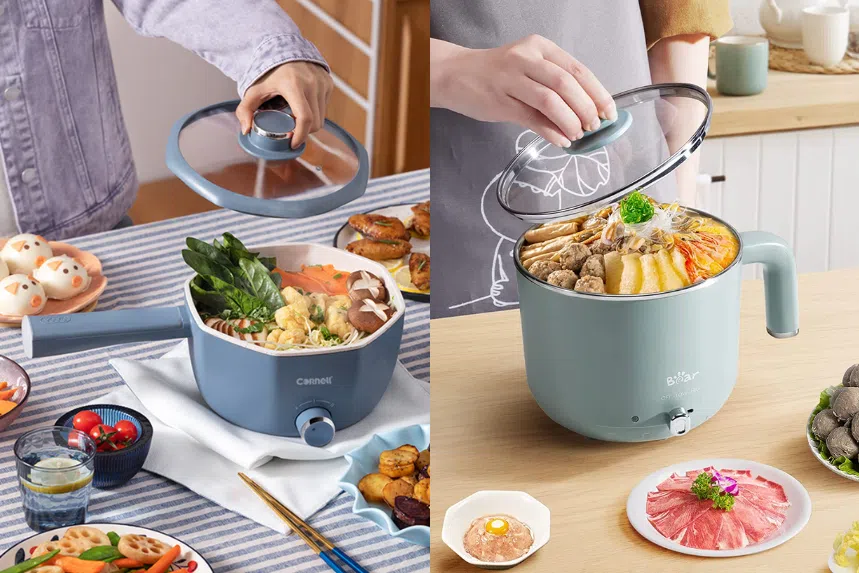
PHOTO: CORNELL, BEAR

Published Feb 27, 2026, 04:00 AM
Updated Feb 27, 2026, 04:00 AM
If you dislike doing dishes, are short on time to whip up meals from scratch and are usually cooking for one, this is your sign to invest in a mini cooker.
The compact kitchen appliance is ideal for making small servings and versatile enough for boiling, frying and steaming various foods.
Whether you love having an at-home mini hot pot or want an
without having to toil over a stove, learn how to pick the best mini cooker to suit your needs.In this article
What is a mini cooker?
What can I cook in a mini cooker?
What to look out for when choosing a mini cooker
Best mini cookers to buy in Singapore
What is a mini cooker?
A mini cooker is an all-in-one appliance designed to prepare foods in a variety of ways, with minimal cleanup required. It comprises an inner pot that is heated up by an electric heating element.
Mini cookers can hold up to 1.5 litres, depending on their model. They are small, lightweight and portable, so they can be easily stored away with other pots and pans.
They are also easy to clean and have simple, user-friendly controls that let you switch between low and high cooking modes.
What can I cook in a mini cooker?
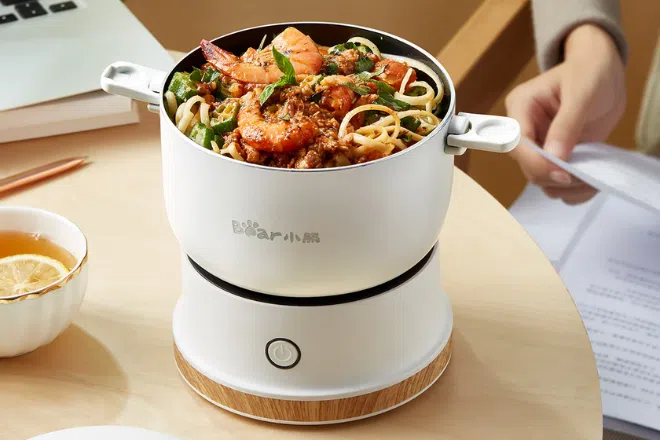
PHOTO: BEAR
Mini cookers are best for small households that prefer to have freshly-made food every day. To get a quick, fuss-free meal, just add ingredients and wait.
For example, ingredients for one-pot dishes like stews and soups can be added in the morning and slow-cooked for hours, before a meal later in the day.
Chinese New Year only comes around once a year, but the love for having steamboat transcends the festive season. Instead of preparing a meal with a full-sized
, you can have a single-person mini hot pot meal at home.Here are some other ways you can use your mini cooker:
Make a 1- to 2-person serving of rice or porridge
Heat or warm items such as dumplings and buns
Stir-fry vegetables and meats
Boil pasta or noodles
Poach chicken and fish fillets
Make desserts like banana cake
What to look out for when choosing a mini cooker
It’s not the size of the appliance but how it can perform in the kitchen - and it’s clear the mini cooker comes out top. When shopping for one, here are some factors to consider before making your purchase.
1. Mini cooker capacity
This might sound like counterintuitive advice, but you don’t want a mini cooker that is too small.
A 1-litre mini cooker will save countertop space, but is unlikely to be large enough to comfortably accommodate a packet of noodles and ingredients like a handful of fishballs.
If having a mini hot pot is your priority, look for one with at least a 1.5-litre capacity. There should be space for the soup to boil without bubbling over.
2. Dual power settings for cooking and keeping food warm
Ideally, you want to be able to cook your food over a precise and adjustable temperature range. However, most mini cookers have extremely simple settings. The most basic and affordable ones only have an on/off switch.
To get the most use out of your mini cooker, choose one that has a low and high power cooking mode. A low power mode allows you to simmer broths and keep food warm; a high power mode lets you quickly boil soups and stir-fry vegetables.
3. Material of your mini cooker’s inner pot
Depending on your preference, choose a mini cooker with an inner pot made of ceramic, stainless steel or one with a non-stick coating.
Stainless steel pot: Food tends to cook more quickly, but if you aren’t careful, ingredients can get stuck to the bottom.
Ceramic pot: The natural non-stick material is easy to clean, but the pot can break more easily than one made of metal.
Metal pot with a non-stick coating: Less oil is required to cook food and cleaning the pot is effortless. However, with repeated use and high heat, the coating does degrade over time. Furthermore, the non-stick coating can be damaged if scratched by metal utensils.
4. Features of the mini cooker
Most importantly, you want to safely cook without tripping the circuit breaker. Look for a pot with auto-shut off safety features in case of overheating or spills.
For those intending to eat straight from the pot - like in the case of a mini hot pot - choose one that has a cool-touch exterior. This way, you can comfortably and safely eat without worrying about accidental burns.
Also, a removable inner pot and power cord would make cleaning more convenient.
Best mini cookers to buy in Singapore
Mayer Personal Electric Cooker With Ceramic Pot, $38.90
Original price: $49.90 (22 per cent off)
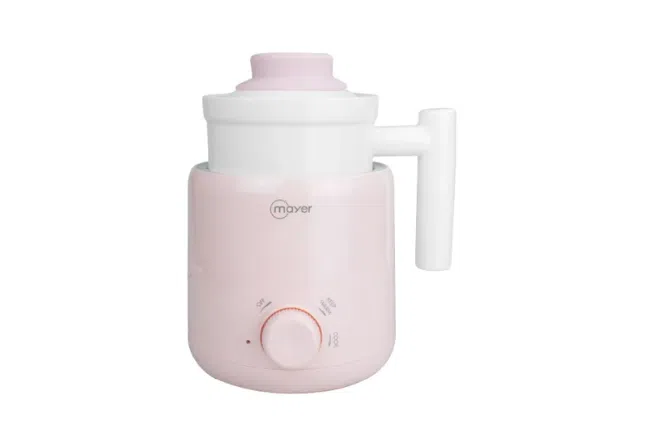
PHOTO: LAZADA
This small and compact mini electric cooker quickly heats up and cooks food evenly. For best results, do not fill the ceramic pot to the brim to prevent liquid from bubbling over.
As you eat, toggle the settings to “keep warm” to ensure your meal remains hot. The 600ml mini cooker also comes in white.
Bear 1.2L Travel Cooker, $35.90
Original price: $79.90 (55 per cent off)
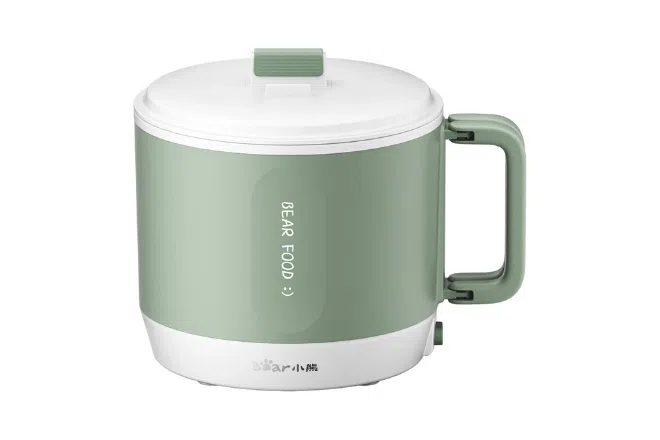
PHOTO: LAZADA
This Bear mini cooker has a ceramic coated inner pot that heats up quickly. You can move the cooker around safely by grabbing it securely but the large handle on the side.
Additionally, it comes with overheat protection, so you can simmer your stews and boil your soups for hours without worry.
La Gourmet Ray of Hope 1.6L Multi Cooker, $39.90
Original price: $69.90 (43 per cent off)
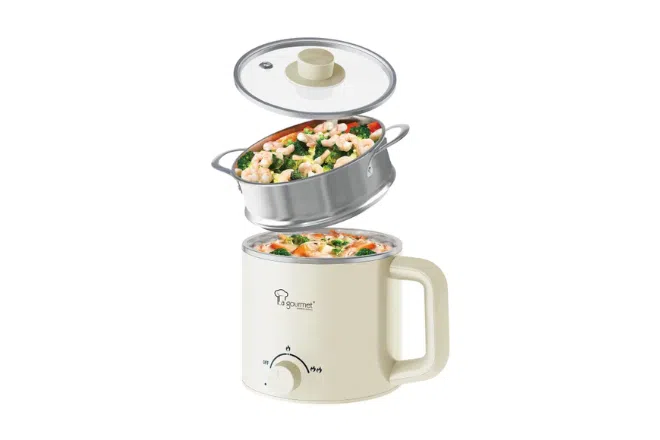
This 1.6-litre mini cooker from La Gourmet multi cooker comes with a stainless steel inner pot and steamer tray.
Monitor your food as it cooks, by looking through the transparent tempered glass lid. You can safely move the appliance around via its ergonomic bakelite handle.
Cornell 1.5L Mini Multi Cooker, $37.90
Original price: $44.90 (16 per cent here)
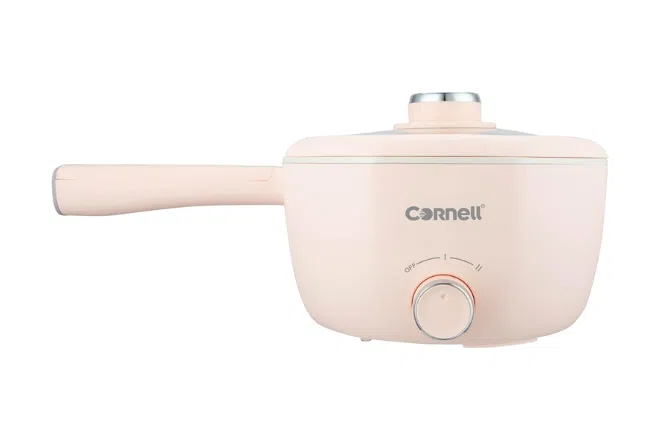
PHOTO: AMAZON
Boil, steam, or have a steamboat with this durable 1.5L mini cooker. Easily transfer your meal into a bowl or move the pot around using the long handle.
The double-wall cool-touch feature ensures that no accidental burns happen if you touch the cooker’s surface.
IONA 1.2L Ceramic Non Stick Mini Multi Cooker, $28.31
Original price: $54.80 (48 per cent off)
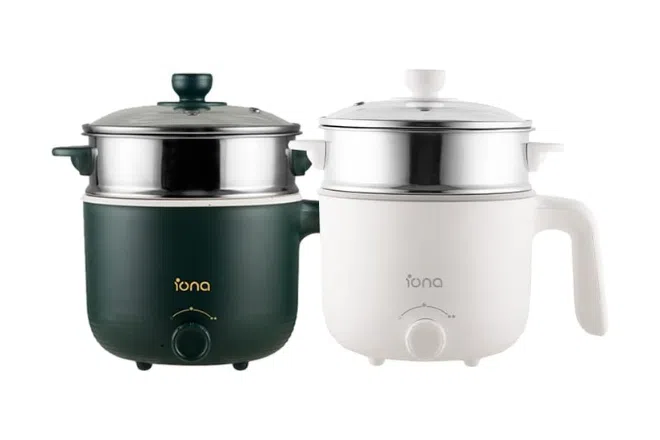
PHOTO: AMAZON
Switch between the 2-level temperature controls in this IONA mini cooker. The inner pot is made of non-stick ceramic and it comes with a stainless steel steamer rack.
While the fast boiling option does heat up water in the inner pot quickly, some users have left reviews saying there is no auto-off safety function should the liquid bubble over.
Cornell 1.5L Mini Multi Cooker with Steam Tray, $26
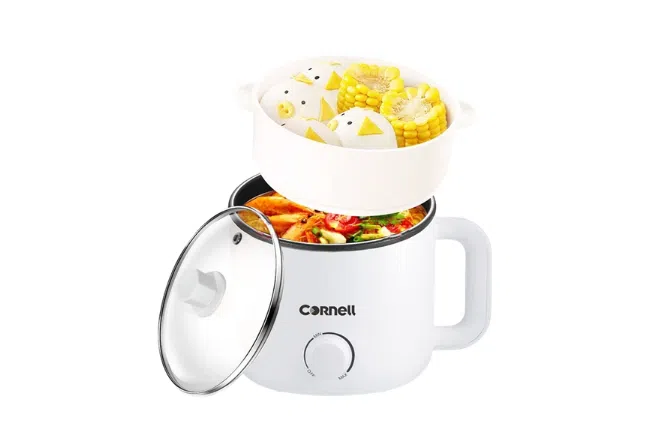
PHOTO: LAZADA
The 1.5-litre pot is made of stainless steel and can get water boiling in just three minutes. It comes with a steam tray which can hold a small amount of food.
When you’re not using the mini cooker for steamboat, you could use it to whip up a variety of dishes - cook noodles, saute vegetables, make fried rice and more.
Simplus Kit 1.8L Electric Cooker, $32.93
Original price: $68.90 (52 per cent off)
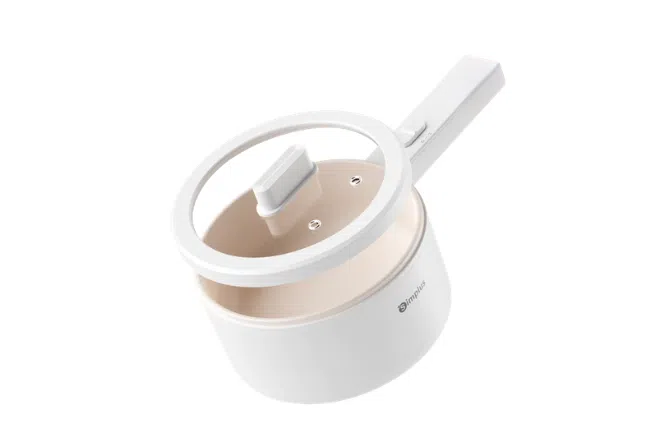
PHOTO: SHOPEE
For those who want a larger cooker, consider this Simplus model. It’s the perfect size for a mini hot pot for two.
This titanium-infused non-stick ceramic pot heats up quickly, thanks to the upgraded heating plate. To keep cooking safe, it comes with dry-burn prevention and high-temperature power-off protection features.
All prices and deals are correct at time of publication
FAQs: Best mini cookers
What is the smallest size cooker?
Some of the smallest mini cookers have a 0.6-litre capacity. You can cook about two cups of rice with a petite cooker of this size.
Can you cook meat in a mini rice cooker?
Yes, you can cook meat in a rice cooker. But if you are intending to stir-fry your meat, try using thinner slices for quicker and more even cooking.
How long to cook rice in a mini cooker?
Two cups of rice should take about 20 minutes on average. However, this will depend on the strength of your mini cooker.
What is the difference between a mini rice cooker and a mini cooker?
can double up as a mini cooker if you treat it as a hot plate with one fixed temperature.But a mini rice cooker is a specialised tool made to cook rice efficiently. Not only are you more likely to get perfectly cooked and fluffy rice every time, but the rice is also likely to cook faster than if you used a mini cooker.
This article contains affiliate links. If you buy through these links, we may earn a small commission.
See more on
Recommended buys


All products have been vetted by the SPH Media shopping team. We may earn an affiliate commission if you buy through our links.
Subscribe to:
Comments (Atom)


 Posts
Posts


